【BON音樂】《法國音樂二十世紀英雄人物》德布西 – 從生平到創作全解析
Claude Debussy: Life to Music
– 資訊整理共享於網路,一起欣賞音樂與藝術之美 –
蹦藝術 | BONART
蹦藝術與雅痞書店合作之《德布西冥誕160週年 特別企劃》系列講座,以三場講座的規格,分別為您詳解「德布西 – 從生平到創作全解析」、「德布西《牧神午後前奏曲》V.S.現代芭蕾之美 」以及「德布西 交響素描《海》V.S.日本浮世繪之美」等三大主題。
→課程連結


主講人:林仁斌(蹦藝術網站執行長)

系列ㄧ、《法國音樂二十世紀英雄人物》德布西 從生平到創作全解析
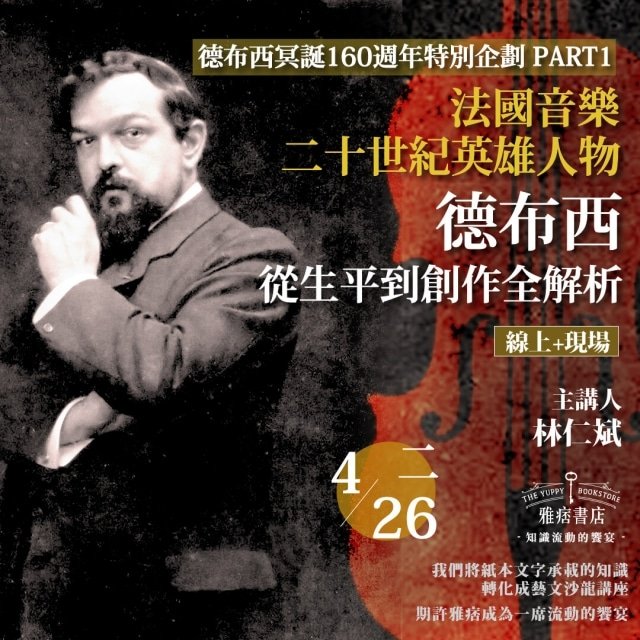
- 「月光、牧神、阿拉貝斯克」法國印象樂派作曲家德布西(Debussy)
德布西生平、作品介紹與音樂欣賞
以一曲《牧神的午後》前奏曲敲響現代管弦之聲的法國作曲家德布西,其獨特的全音階使用,呼應甘美朗音樂的多層次朦朧美,讓他在所有近代作曲家中獨樹一格,並被法國人視為最具代表性之音樂家之一。
鋼琴曲《月光》更是許多影視作品中廣為引用之經典作品(如電影《暮光之城》);而德布西從鋼琴作品、歌曲至管弦樂創作,皆有獨到之處,其充滿個人色彩之細膩音樂作曲風格也是本場講座中最值得聽眾們細細品味之處。
電影《暮光之城》的《月光》片段
《月光》五分鐘教學 – 巴倫波因
法國音樂的榮光.德布西

1913年,德布西於巴黎錄下的「Welte-Mignon系統」珍貴錄音:
《葛拉納達的黃昏》(La soirée dan Grenade)
青少年時期(1862-1887)
(作曲家基本資料整理於網路與維基百科,並附上超連結方便檢索)
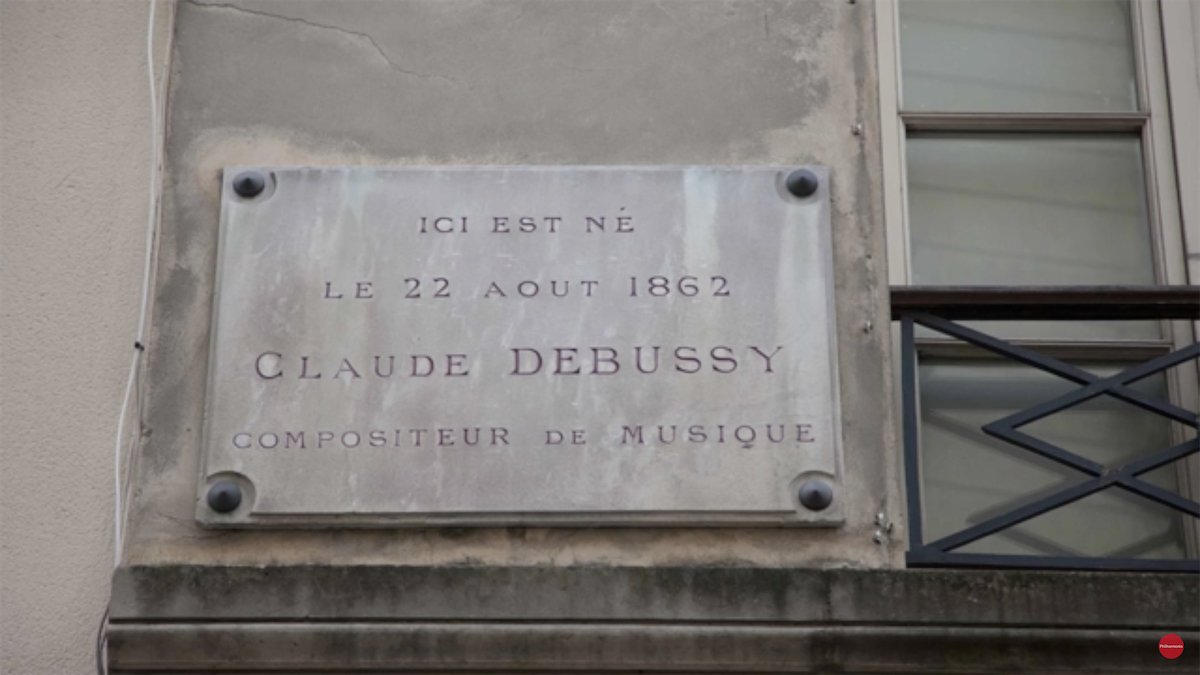
德布西在1862年8月22日誕生於法國巴黎近郊聖日耳曼昂萊鎮(Saint-Germain-en-Laye, FR),德布西來自於中產階級的小家庭:父親馬努耶爾-阿希爾(Manuel-Achille Debussy, 1836-1910)與母親薇托琳(Victorine Manoury Debussy, 1836-1915)開在小鎮裡的陶器店。三歲時陶器店因業績不佳而倒閉,不久後,全家搬入巴黎市區展開新生活,這期間為維持家計,父親曾任售貨員以及印刷工廠工人,母親則轉任裁縫師,一家人攜手過著簡單的日子。
1906年左右,德布西與雙親的合照

現在,德布西位於聖日耳曼昂萊鎮(Saint-Germain-en-Laye, FR)的出生房子,已經修建為德布西博物館:

音樂之路的開始
1871年時,父親馬努耶爾因「巴黎公社事件」而入獄,在獄中結識了詩人魏倫 (Paul-Marie Verlaine, 1884-1896) 的岳母:莫泰夫
人 (Mme Mauté de Fleurville, 1823-1883),後來德布西透過父親而認識她。
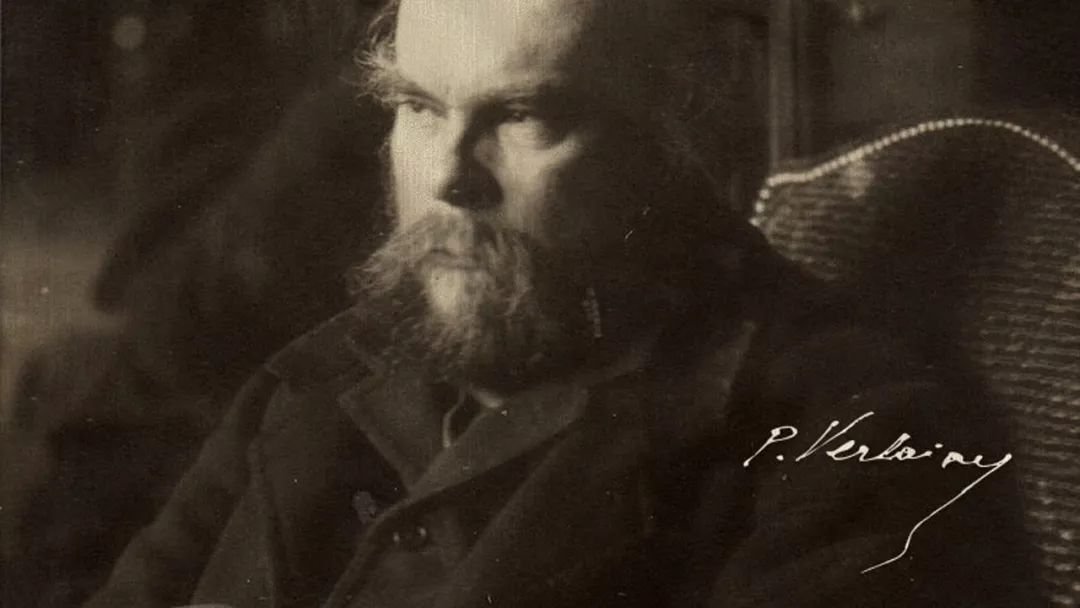
象徵派詩人 – 魏倫 (Paul-Marie Verlaine, 1884-1896)照片,德布西著名的《月光》靈感正來自於魏爾倫的同名詩《月光》,而魏倫詩中所提到的Bergamasques,也成為了德布西創作的《貝加馬斯克組曲》(Suite bergamasque)標題名稱 。(筆者註:《貝加馬斯克組曲》由⟨前奏曲⟩(Prélude)、⟨小步舞曲⟩(Menuet)、⟨月光⟩(Clair de lune)和⟨巴瑟比埃舞曲⟩(Passepied)等四個樂章組成)
魏倫《月光》中法翻譯
─ 保爾‧魏爾倫(Paul Verlaine),〈月光〉(Clair de Lune)
(翻譯出處連結)
| 法文 | 中文 |
|---|---|
| Votre âme est un paysage choisi
Que vont charmant masques et bergamasques Jouant du luth et dansant et quasi Tristes sous leurs déguisements fantasques. Tout en chantant sur le mode mineur L’amour vainqueur et la vie opportune Ils n’ont pas l’air de croire à leur bonheur Et leur chanson se mêle au clair de lune,Au calme clair de lune triste et beau, Qui fait rêver les oiseaux dans les arbres Et sangloter d’extase les jets d’eau, Les grands jets d’eau sveltes parmi les marbres. |
你的靈魂是絕美風景,
貝加馬斯克面具令人忘情, 魯特琴伴奏中舞蹈歌唱, 奇特裝扮下暗藏傷心。 他們以小調吟唱, 詠歎愛的勝利與生之歡慶, 他們似乎不相信自己的幸福, 歌聲混在月光裡。寂靜月光,哀愁美麗, 讓鳥兒在樹叢中入夢, 使噴泉因狂喜而啜泣, 在大理石像間飛騰入空。 |
莫泰夫人(Mme Mauté de Fleurville)本身是一位優秀的鋼琴家,曾是蕭邦 (Frédéric Chopin, 1810-1849) 的入室弟子,也可說是德布西音樂才華的啟蒙者。

她教授德布西彈鋼琴,並在1872年時,幫助德布西進入巴黎音樂院,負擔起他大部分的學費。
入學巴黎音樂院後,德布西師從鋼琴家安東尼.馬蒙泰 (Antoine François Marmontel, 1816-1898)鋼琴高級班,馬蒙泰教授也是最先發掘德布西的音樂特質 與眾不同的老師,並且也肯定了他的音樂才能。
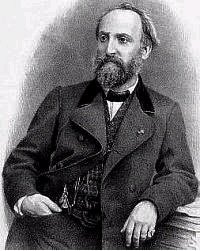
馬蒙泰於 1848年至 1887年間任教於巴黎音樂院,他所教過的傑出學生有:比才(Georges Bizet)、丹第(Vincent d’ Indy)、Francis Plante、Louis Diémer、Émile Paladilhe、Albert Lavignac、德布西(Claude Debussy)與瑪格麗特.隆(Marguerite Long)等等。
求學過程

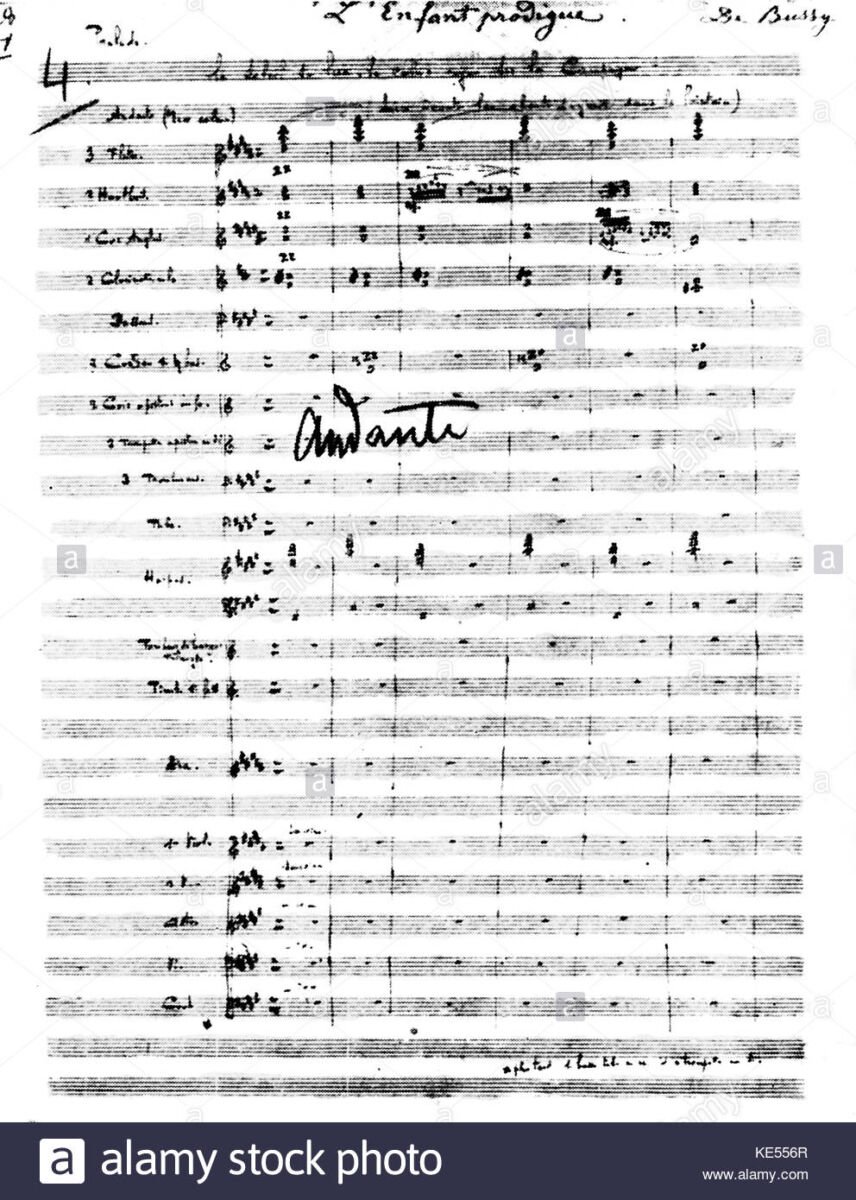
1884年時,德布西以《浪子》(L’Enfant Prodigue, 1884) 這部作品奪得羅馬大獎,並獲得到羅馬留學的機會,在此期間他也認識了李斯特 (Franz Liszt, 1811-1886)。李斯特鼓勵他在羅馬的小教堂內演奏文藝復興時期作曲家帕勒斯替那 (Giovanni Pierluigi da Palestrina, 1525-1594) 及 拉索 (Orlando di Lasso, 1532-1594) 的作品,他們的對位寫作方式令德布西讚嘆不已,並開啟了他日後創作的不同視野。
德布西《浪子》手稿
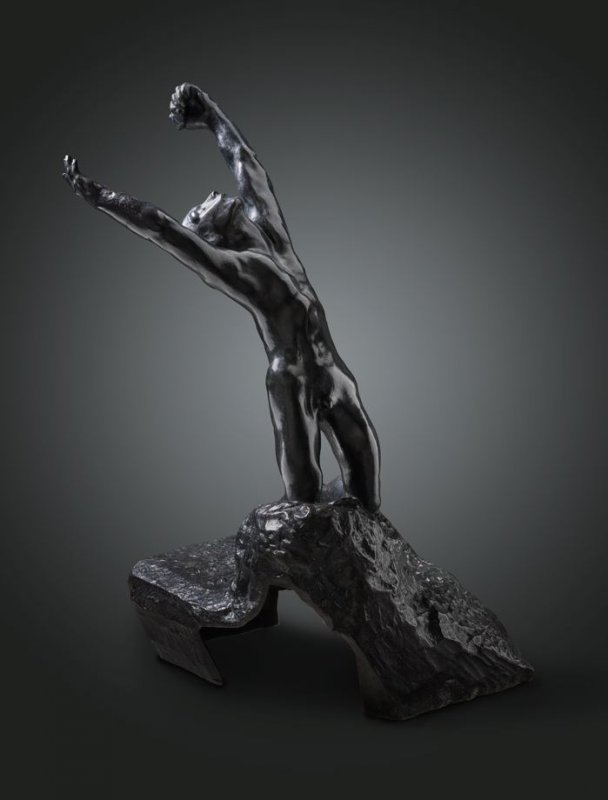
雕刻家 羅丹(Auguste Rodin, 1840-1917)同名作品欣賞
浪子 L’enfant prodigue
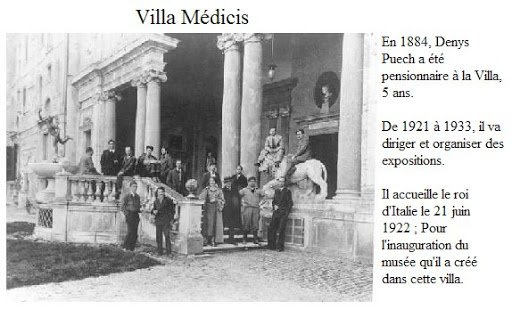
德布西於1884年獲得羅馬大獎後的2月份,居住於義大利羅馬梅帝奇別墅(Villa Médicis):

年輕的德布西,1885年與友人們留影於義大利梅帝奇別墅:(找得到德布西在哪裡嗎?)
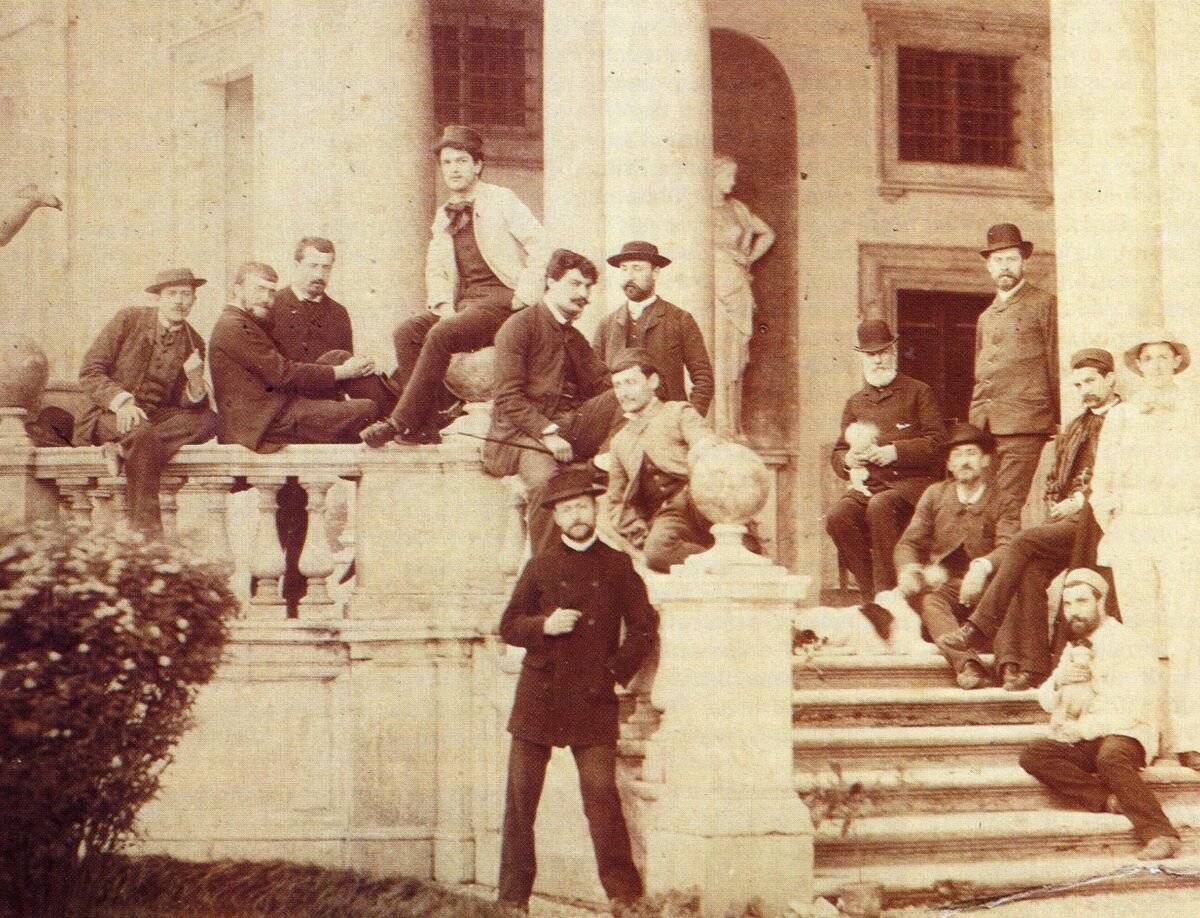
看來在那個年代,這邊應該是「網美」景點XD
音樂風格大轉變
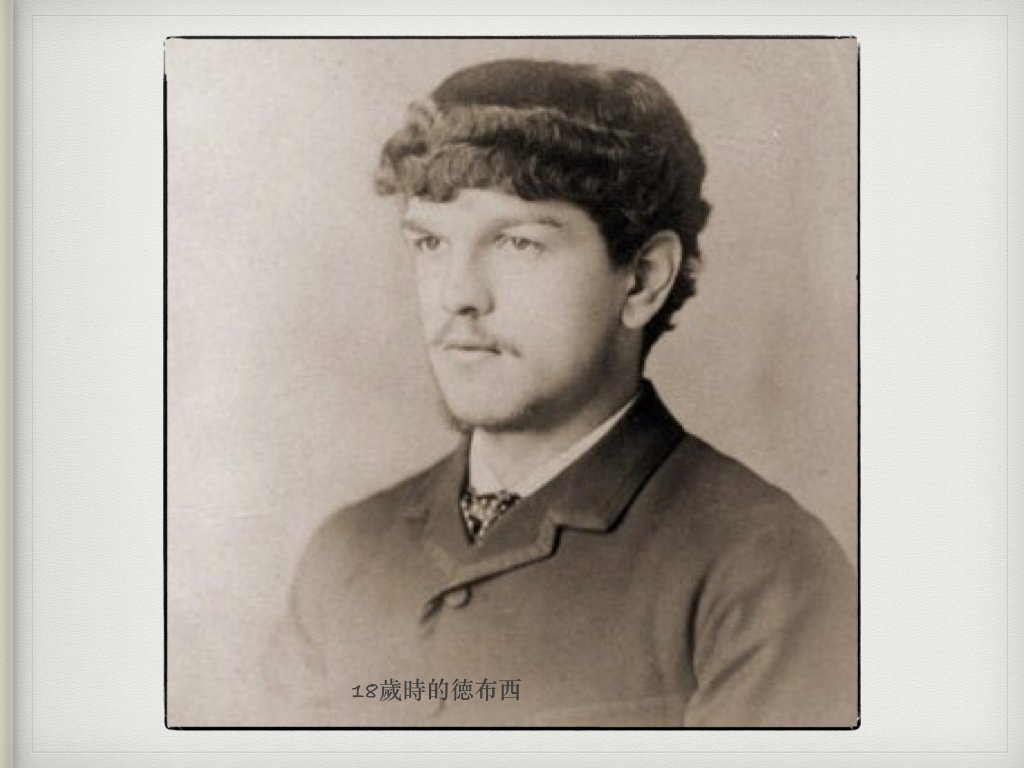
1879年的德布西照片(17歲)

1887年起,德布西兩次走訪華格納 (Richard Wagner, 1813-1883) 歌劇的演出主場:拜魯特 (Bayreuth),聆聽華格納知名作品《崔斯坦與伊索德》(Tristan und Isolde, 1859) 以及《帕西法爾》(Parsifal, 1877-1882)。

當時法國的音樂環境氣氛明顯受到普法戰爭的戰敗結果所影響,一派以法蘭克等作家為首之作曲家,認為以華格納為首的輝煌交響效果,是音樂家接應該仿效的。
另一派以聖桑、薩提為代表,則認為法國人應該找出自己的音樂風格,走出屬於自己的路。
德布西原本十分傾慕華格納,但後來其思想受俄國國民樂派、東方音樂以及象徵主義的影響,並有感於華格納旋風的威脅,決心要創作出屬於法國的音樂,不屈服於歐洲的華格納風潮下。
聖桑的特殊貢獻
1870年,聖桑參與了國家防衛軍,並參加了普法戰爭。1871年普法戰爭後,為激勵法國作曲家的創作與發揚法國新音樂精神,而創立國家音樂協會(National Society of Music)。聖桑以組織主席身分,公開首演社團成員的作品,包括佛瑞、法朗克、拉羅及他本人的作品,逐漸地他成為塑造法國音樂將來的重要人物。
聖桑一生中的各項活躍,顯現他是一位思慮完整且充滿創新與復古精神並存的矛盾傑出人物:作為一個古典主義出發的藝術創作者者,他同時也在自己所生活的浪漫主義時代,寫作出帶有浪漫風格的創作,但在作曲手法與風格上,卻不落俗套且深受古典主義影響。而作為當代法國交響樂和室內樂的先驅,他的努力寫作與推廣,更讓他成為了當代權威音樂家。
提攜後輩的不遺餘力,並對當代法國音樂發展有著影響卓著的貢獻。

回顧法國在普法戰爭(1870年)中戰敗後,他的思想中即出現了明確的民族主義,並於1871年與巴黎音樂學院的歌唱教授羅曼·布辛(Romain Bussine)一起創立了法國國家音樂學院——正如當時的一份成立聲明所述:「幫助法國作曲家創作和普及所有嚴肅作品,無論是否出版」。而音樂學院早期的成員包括 Duparc、Fauré、Franck 和 Massenet等人。

如果當時沒有成立法國國家音樂學院,許多我們現在熟知的19世紀晚期法國最重要的管弦樂和室內樂作品,您可能永遠不會聽到——或者,事實上,不會被寫出來。
至此,德布西已經準備走向全新的未來。

音樂欣賞:《水的倒影》(Reflets dans l’eau)
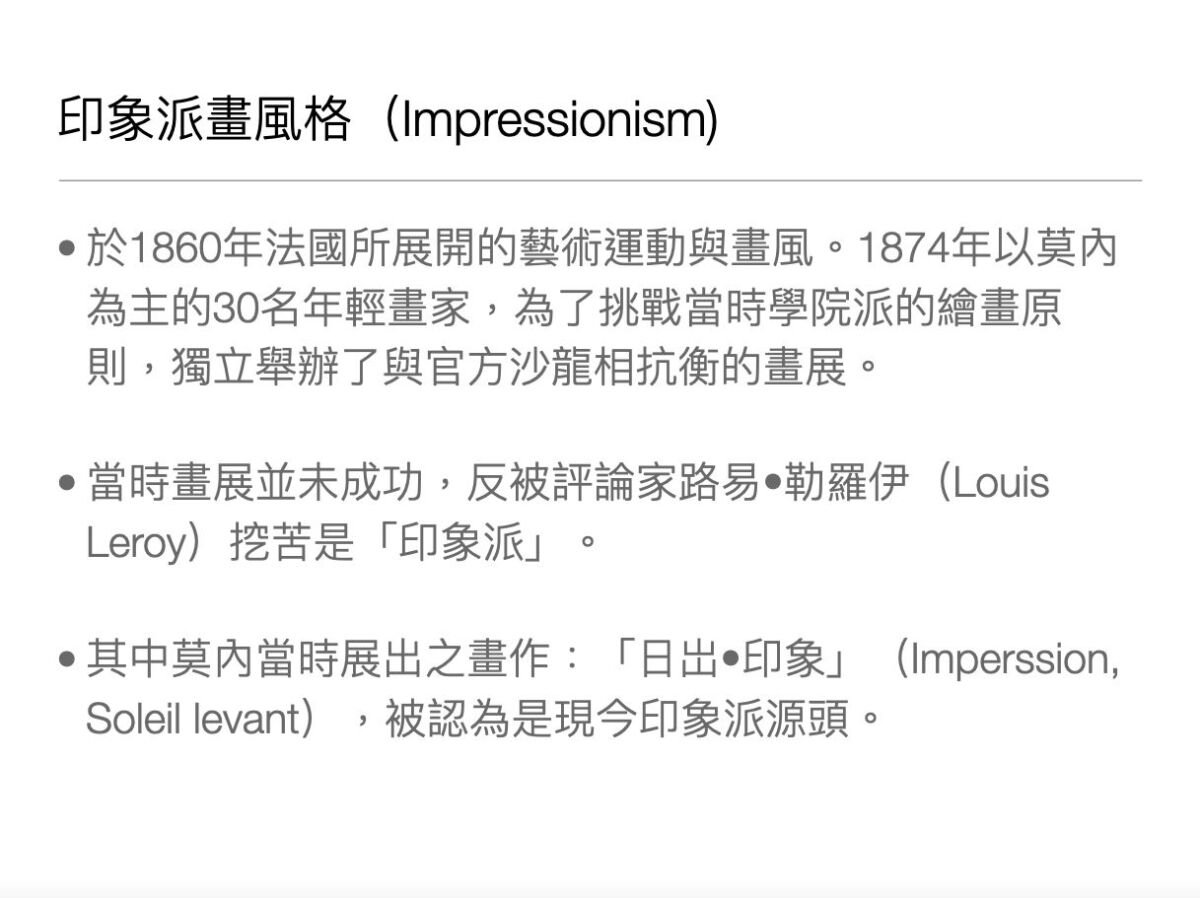
印象派的由來
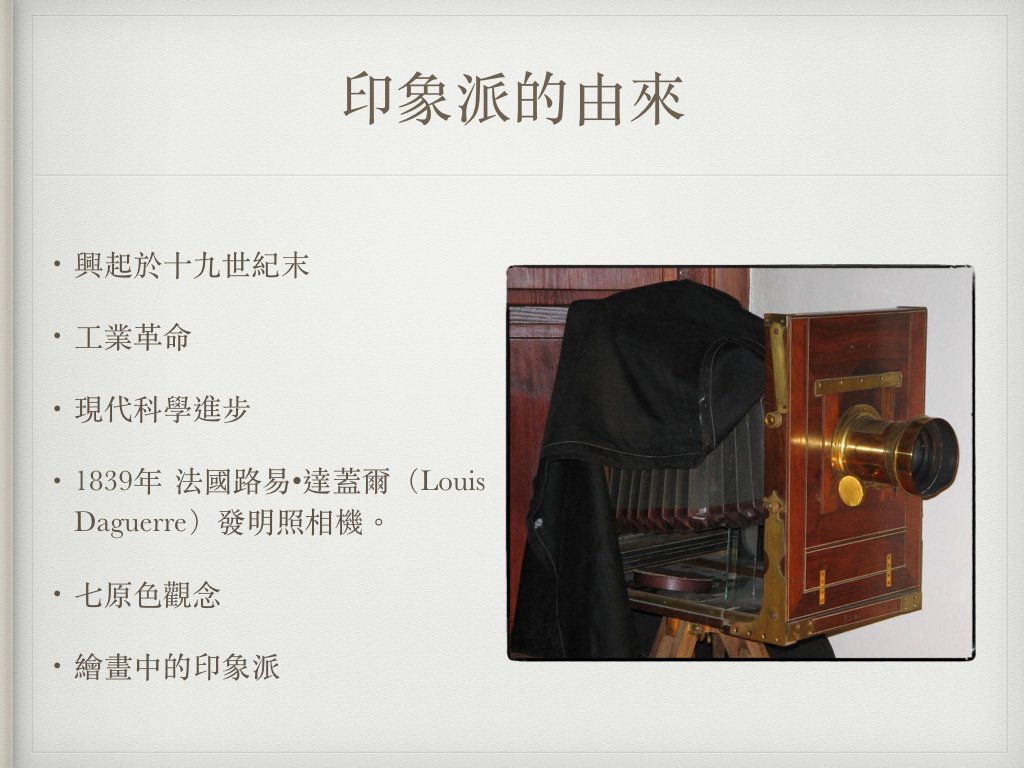
ㄧ、攝相技術的發明


二、繪畫風格之轉變
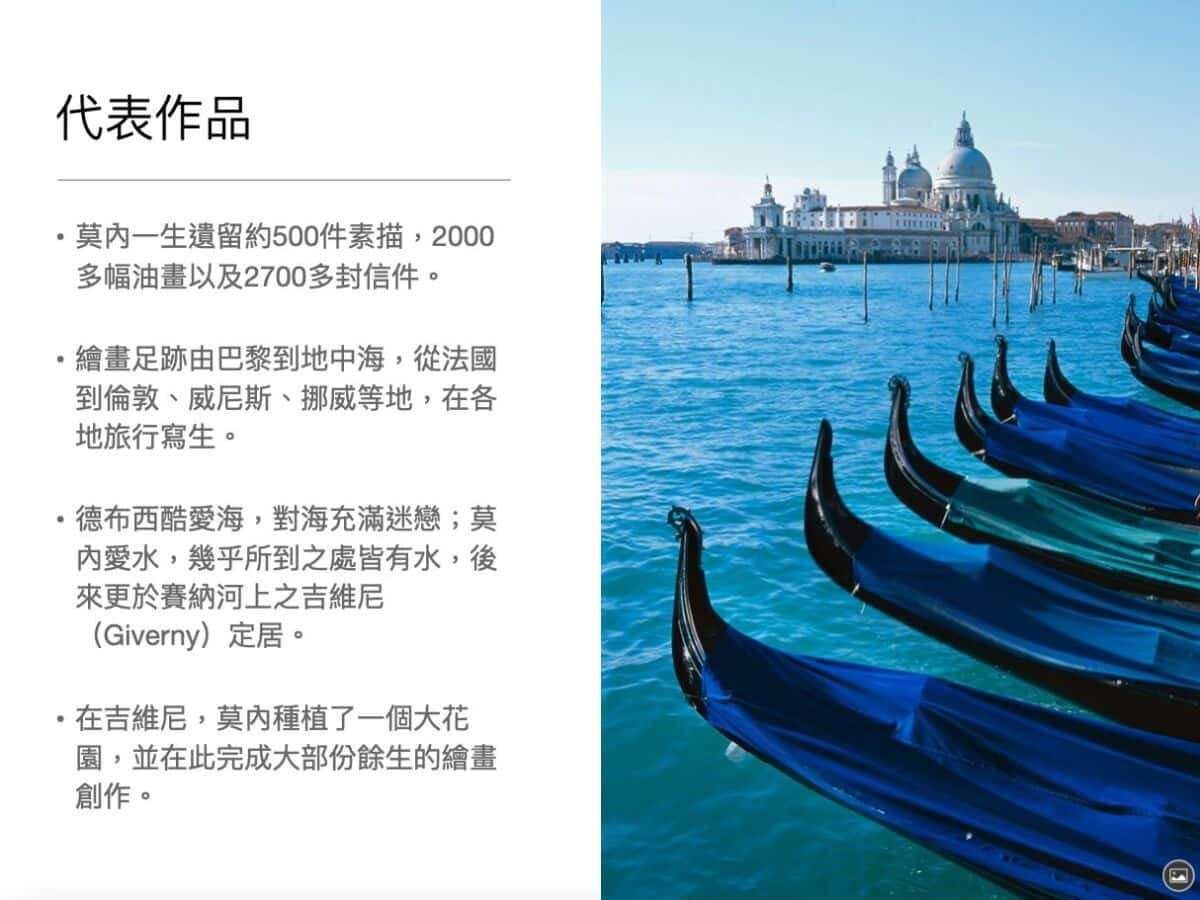
萬國博覽會
1889年德布西參觀了在巴黎舉行的萬國博覽會(Universal Exhibition),首次接觸了來自爪哇的甘美朗音樂(Gamelan), 立即被此形式與節奏的自由、具有東方神秘色彩、五聲音階調式的新鮮音樂風格所深深吸引,他對東方異國情調的音樂產生濃厚的興趣。加上他對華格納音樂的理解,由認同改為要與之抗衡~於是他的內心開始進行了激烈的想法,思考著未來創作的方向。


1889年萬國博覽會

1889年世界博覽會在法國首都巴黎舉行,自5月6日至10月31日,為期共150天,目的是紀念法國大革命起點——巴士底監獄暴動——百週年,在這場世界博覽會,艾菲爾鐵塔成為最耀眼的代表,於1889年建立完成,並且以它作為展覽會場的入口。

這場博覽會有三十五個國家參展,佔地0.96平方公里(九十六公頃),包括戰神廣場、the Trocadéro、奧塞碼頭、一部份的塞納河和榮軍院。總計花費:41,500,000法郎,回收金額49,500,000法郎,人次:32,250,297人。
《海》與甘美朗音樂(5’26″)

德布西《版畫》組曲中,共包含三首小品,分別為塔(Pagodes)、格拉納達的黃昏(Soirée dans Grenade)、雨中庭園(Jardins sous lapluie)。
延伸閱讀
塔(Pagodes)(文字引用自鋼琴家廖皎含音樂網站)
1889年,德布西在巴黎世界博覽會中聽到甘美朗(Gamelan)音樂,立刻被具有濃厚東方色彩的音樂所吸引,因而激盪出創作靈感,寫下〈塔〉,當中使用中國五聲音階的羽調式,融合甘美朗音樂中的多層音色渲染,以不同節奏的變化方式反覆出現,營造出濃厚的東方神秘風格,使人聯想起遠東某一場所或建築的映象,此曲不侷限於單純的描寫,而是藉著難以言傳的氣氛,將聽眾引導到如夢似幻、光線纖細的國度。
塔(Pagodes) – 鋼琴版附樂譜
塔(Pagodes) – André Caplet (1878-1925) 管弦樂版
詩人.藝術家的週六聚會
逐漸與詩人、藝術家為友的德布西,也加入了象徵主義詩人們的聚會,開始受到詩人們描繪藝術的各種風格影響,他也開始持續醞釀著音樂上的創作。
牧神午後前奏曲
終於1894年,他根據詩人馬拉梅(Stéphane Mallarmé, 1842-1898)的詩所譜寫的《牧神的午後前奏曲》(Preludé á L’apres-midi d’un faune, 1892-1894)完成,大受各界好評與歡迎,德布西終於從「一位普通的青年作曲家」,轉型成為「具有才氣、光明未來的年輕音樂家」,他終於找到了自己未來的方性,也因為他確立了未來音樂風格的走向,更為法國接下來的20世紀音樂,開創出一條全新的道路。

延伸閱讀
【BON音樂】淺談德布西《牧神午後前奏曲》


音樂欣賞:德布西:<水妖>(Sirenes)
法語歌劇
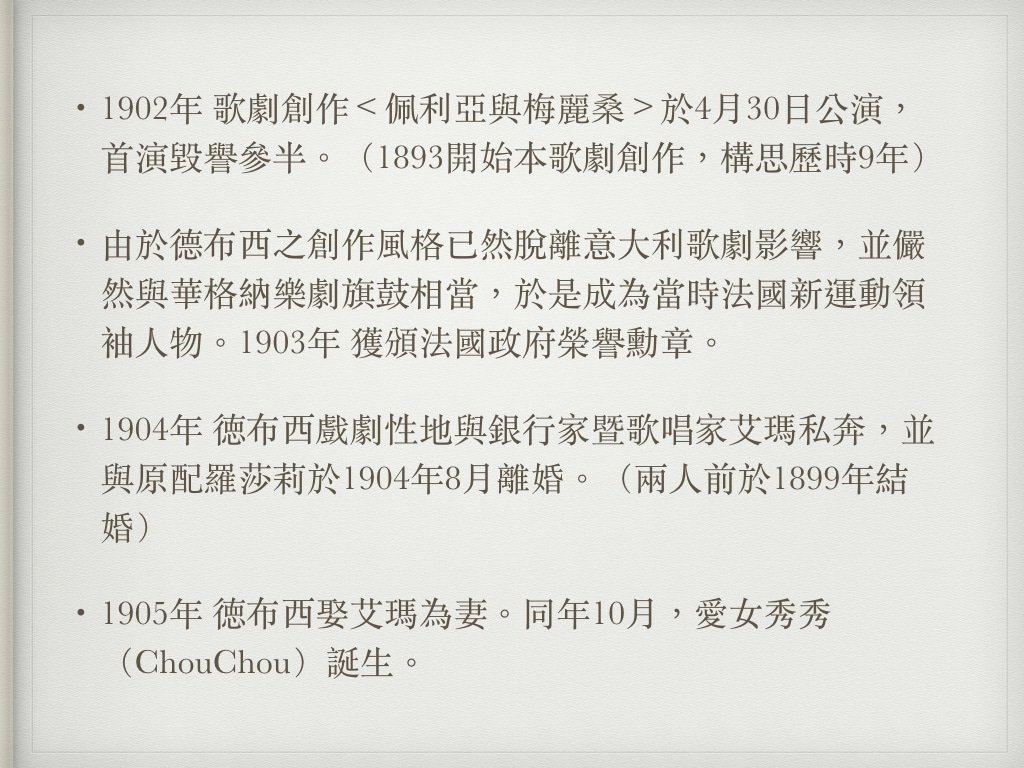
1893年,德布西在看過梅特林克的象徵派話劇「佩利亞與梅麗桑」(Pélleas et Mélisande)後,便構思以此為題材來創作歌劇,在歷經長時間的創作及不斷修改後,終於在1902年在巴黎首演同名歌劇作品《佩利亞與梅麗桑》,雖然首演時未能全面受到好評,但隨著時間的證明,《佩利亞與梅麗桑》不但成為德布西的代表作,更成為法國歌劇界的代表作品之一。
創作力源源不絕
自此之後,德布西成功地開創新的印象主義音樂風格,不斷寫作各類型音樂作品。
自1901年起的十幾年裡,他創作了許多具代表性的印象派作品,例如:《版畫》(Estampes, 1903)、 《海》(La Mer, 1903-1905)、兩集《映象》 (Images, 1905, 1907)、《兒童世界》 (Children’s Corner, 1906-1908)、《快樂島》(L’isle Joyeuse, 1904) 等等,
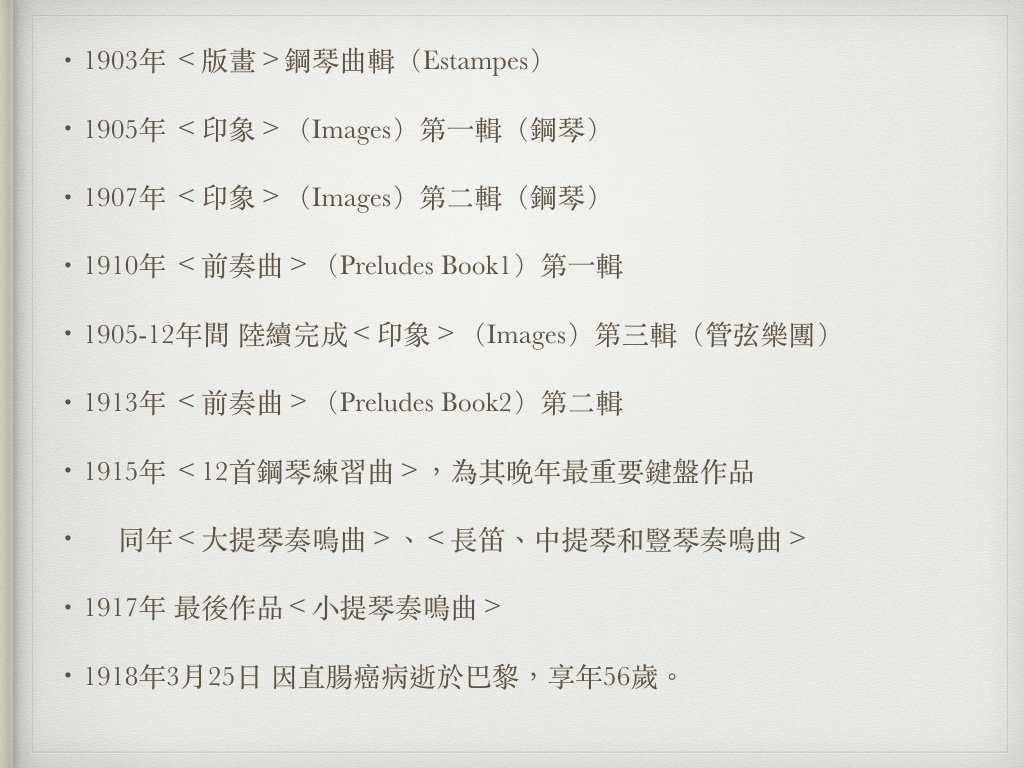
兩段婚姻


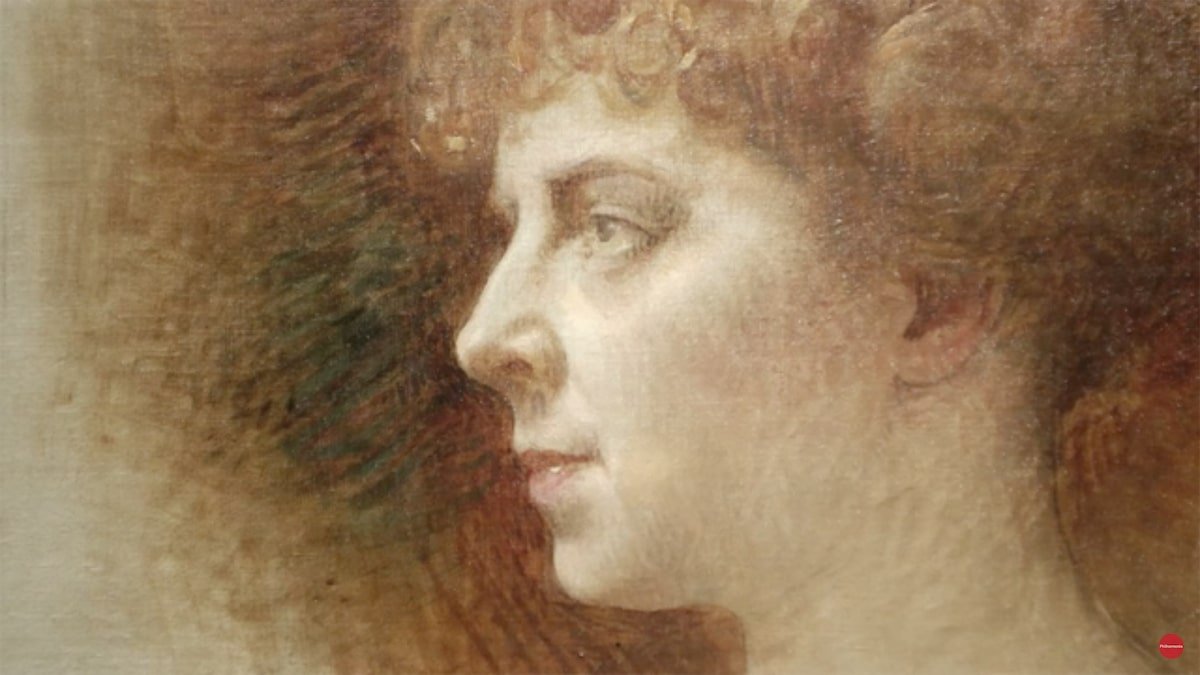
德布西的前後兩任妻子
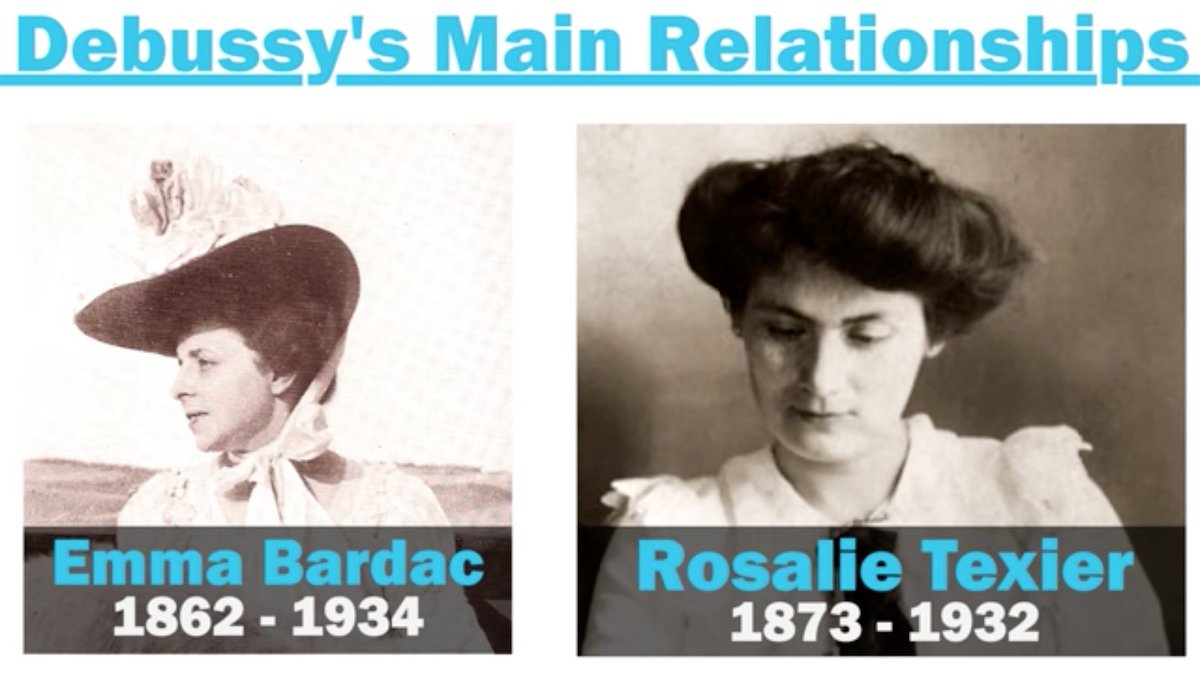
德布西與女兒 Claude-Emma(小名 ChouChou)

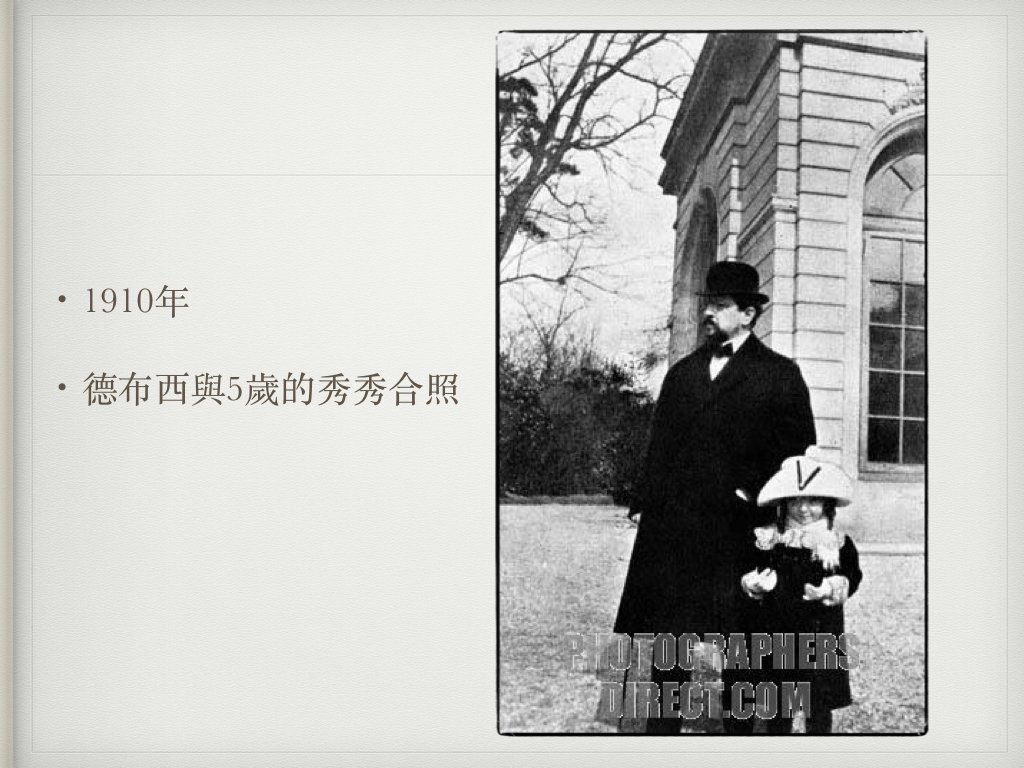

《兒童天地》完成於1908年,在樂譜的扉頁,德布西寫道:「以下這些曲子,是父親最溫柔的心聲,獻給我最寶貝的秀秀。」秀秀 (Chou-Chou) 是德布西對愛女的暱稱。在這部作品中,可發現德布西的幽默、輕妙、譏誚及對童年的追憶,並藉此抒發了他身為人父,對兒童世界的真摯情感。
共由六曲組成:
《老頑固》(Doctor Gradus ad Parnassum)
《大象催眠曲》(Jimbo’s lullaby)
《洋娃娃小夜曲》(Serenade of the doll)
《粉雪飛舞》(The snow is dancing)
《小牧羊人》(The little shepherd)
《黑娃娃步態舞》(Golliwogg,s Cake-Walk)。
《兒童天地》樂譜版本欣賞
Debussy: Children’s Corner (Crossley, Bavouzet)
Seong-Jin Cho – Debussy: Golliwog’s Cakewalk
德布西與海


延伸閱讀
【BON音樂】淺談德布西:交響素描 «海»(La Mer)
《海》初版封面
日本浮世繪畫家葛飾北齋所匯《富嶽三十六景》之 ⟨神奈川沖浪裏⟩

樂譜封面

20法郎紙幣.背後有玄機


生活照


中國文物.也吸引德布西
除了日本浮世繪之外,德布西也喜愛中國文物,有執扇銅像瓷器、特殊紋路的木櫃、各種動物瓷器與銅器器等等,都是自中國旅遊的友人們知道德布西喜愛東方文物,因此特別帶回法國致贈給他,作為收藏。


回歸絕對音樂
1915年時德布西的創作手法開始回歸絕對音樂,他應用了奏鳴曲式回歸最傳統的作曲手法,並計畫寫作六首奏鳴曲,但只完成三首便與世長辭,這三首作品分別是:
《大提琴與鋼琴奏鳴曲》
《長笛、中提琴與豎琴奏鳴曲》
《小提琴與鋼琴奏鳴曲》

《長笛、中提琴與豎琴奏鳴曲》(Sonate pour Flute, Alto et Harp),是由牧歌(Pastorale)、間奏曲(Interlude)和終曲(Final)三個樂章所組成。這是德布西晚年所寫的三重奏鳴曲中規模最大的一曲,三種平常難得被湊在一起的樂器,透過德布西精密和聲與音域之安排,展現出魅力無窮,且充滿全新色彩的獨創性與演奏效果。
《長笛、中提琴與豎琴奏鳴曲》共有三個樂章:
第一樂章〈牧歌〉(Pastorale)
第二樂章〈間奏曲〉(Interlude)
第三樂章是〈終曲〉(Finale)

原創.探索音樂中的神秘
5 Minutes On… Debussy – Estampes 1. Pagodes | Daniel Barenboim
5 Minutes On… Debussy – Estampes 2. Soirée dans Grenade | Daniel Barenboim
5 Minutes On… Debussy – Estampes 3. Jardins Sous La Pluie | Daniel Barenboim
德布西的樂思源源不絕,一層又一層的音色反映在他使用的三行記譜上:

在德布西故居博物館裡,也有著這樣的《金魚》立體版畫收藏品:

兩冊前奏曲集
1913年德布西完成了二十四首前奏曲,《前奏曲》分為兩集,一集各有十二首樂曲,細膩的創作內容將其鋼琴創作推到顛峰:
第一冊前奏曲,由以下十二首樂曲所組成:《特爾菲的舞姬們》(Danseuses de Delphes)、《帆》(Voiles)、《吹過原野之風》(Le vent dans la plaine)、《飄散在暮色中的聲音和香味 》 (Les sons et les parfumes tournent dans l’air du soir) 、《 阿納卡普利的丘陵 》(Les collines d’ Anacapri)、《雪泥蹤跡》(Des pas sur la neige)、 《西風所見的東西》(Ce qu’a vule vent d’Ouest)、《棕髮女郎》(La fille aux cheveux de lin)、《中斷的小夜曲》(La serenade interompue)、《沈沒的教堂》(La cathedale engloutie)、《迫克之舞》(La danse de Puck)、《遊吟詩人》(Minstrels)。
第二冊前奏曲,同樣有十二首樂曲:《霧 》(Brouillards)、《枯葉》(Feuilles mortes)、《威諾之門》(La Puerta del Vino)、《妖精是出色的舞者》(Les fées sont d’exquises danseuses)、《石南叢生的荒地》(Bruyéres)、《古怪的拉威奴將軍》(General Lavine-eccentric)、《月光下的陽台》(La terrasse des audiences au clair de lune)、《水妖》(Ondine)、《皮克威克卿禮讚 》(Hommage à S. Pickwich, Esq., PPMPC)、《骨壺》(Canope)、《交替的三度》(Les tierces alternées)、《煙火》(Feux d’artifice)。
Debussy: The Complete Preludes (Zimerman)
十二首練習曲集
《十二首練習曲集》完成於1915年,並題獻給蕭邦。德布西在曲集首頁寫下:「為了懷念蕭邦 (1810-1849)」, 以表達對他的敬意。這部作品在和聲、節奏等技巧上,可說是集德布西獨特鋼琴技法之大成,是一部技巧艱深的練習曲。
值得注意的是,德布西在曲中未標示出指法。他在序中指出:「在這部練習曲中,我刻意不註明指法,因為每一個人的手指構造不同,如果硬要指定他人用什麼指法彈奏的話,恐怕不太合理。」由此可得知這部練習曲的與眾不同之處。
這套練習曲集中包括了十二首樂曲:《為全部五隻手指》(Pour les cing doigts)、《為三度的》(Pour les tierces)、《為四度的》(Pour les quartes)、《為六度的》 (Pour les sixtes)、《為八度的》(Pour les octvaes)、《為八隻手指的》(Pour les huit doigts)、《為半音階的》(Pour les degres chromatiques)、《為裝飾音的》(Pour les agrements)、《為重複音》(Pour les notes repetees)、《為對比音響的》(Pour les sonorites oposees)、《為琶音的》(Pour les arpeges composes)、《為和弦的》(Pour les accords)。
Debussy – Étude 1 pour les cinq doigts d’après Monsieur Czerny(Walter Gieseking)
最後遺容與墳墓
1917年9月14日舉行了德布西的最後一場作品音樂會(小提琴奏鳴曲首演)之後,德布西於1918年初開始臥床不起,後於1918年3月25日,德布西因直腸癌於巴黎逝世,未能等到第一次世界大戰結束的和平再臨,享年55歲。
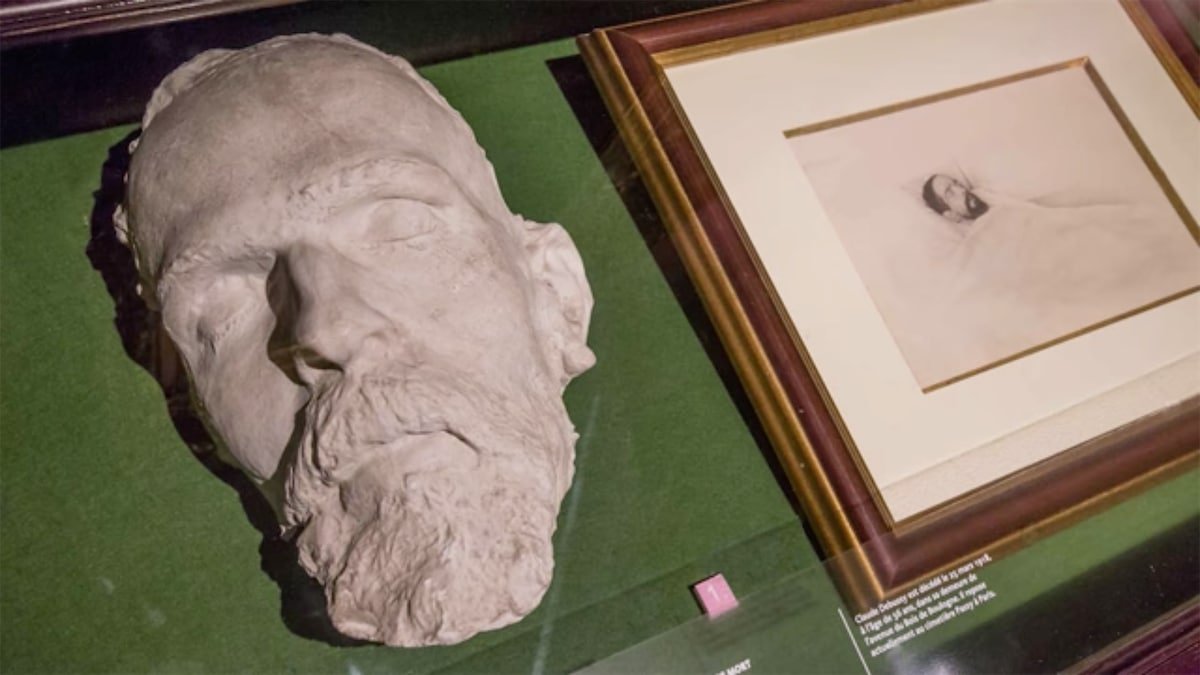
在德布西去世之時,第一次世界大戰仍在肆虐,巴黎依舊受到德國的空中侵襲與大砲轟炸。嚴峻的軍事形勢不允許舉行具有隆重墓地以及告別演說的公開葬禮。於是德布西的葬禮就在德軍炮火依舊轟炸這座城市時,送葬隊伍悄悄穿過空蕩蕩的街道,前往拉雪茲神父公墓的臨時墳墓。
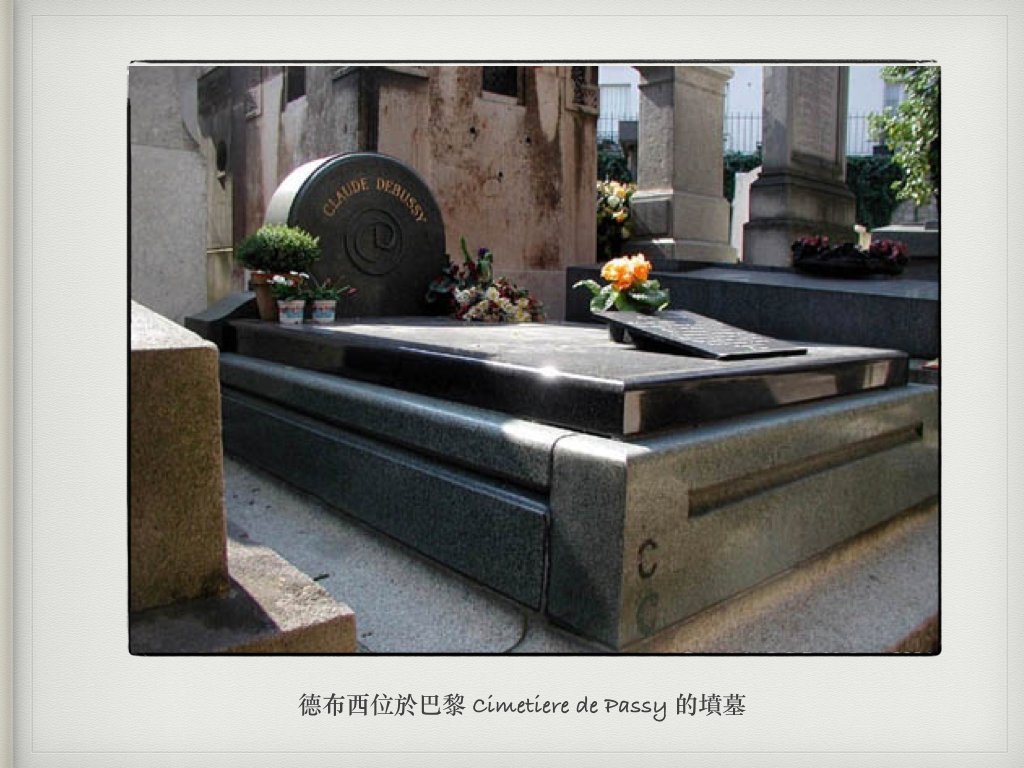
隔年,德布西的遺體被重新安葬在位於 Trocadéro 後面的小帕西公墓,也實現了他想要“在樹木和鳥兒之間”安息的願望。後來他的妻子和女兒也都在過世之後,與他安葬在同一處。
德布西的手稿去處
德布西過世之後,遺孀Emma Bardac則將他的手稿整理並開始出售給各單位,法國國家圖書館是主要的購買方。也因此目前許多德布西重要手稿均可在法國國家圖書館中閱覽,給後世音樂學者與音樂家們研究這珍貴的音樂遺產
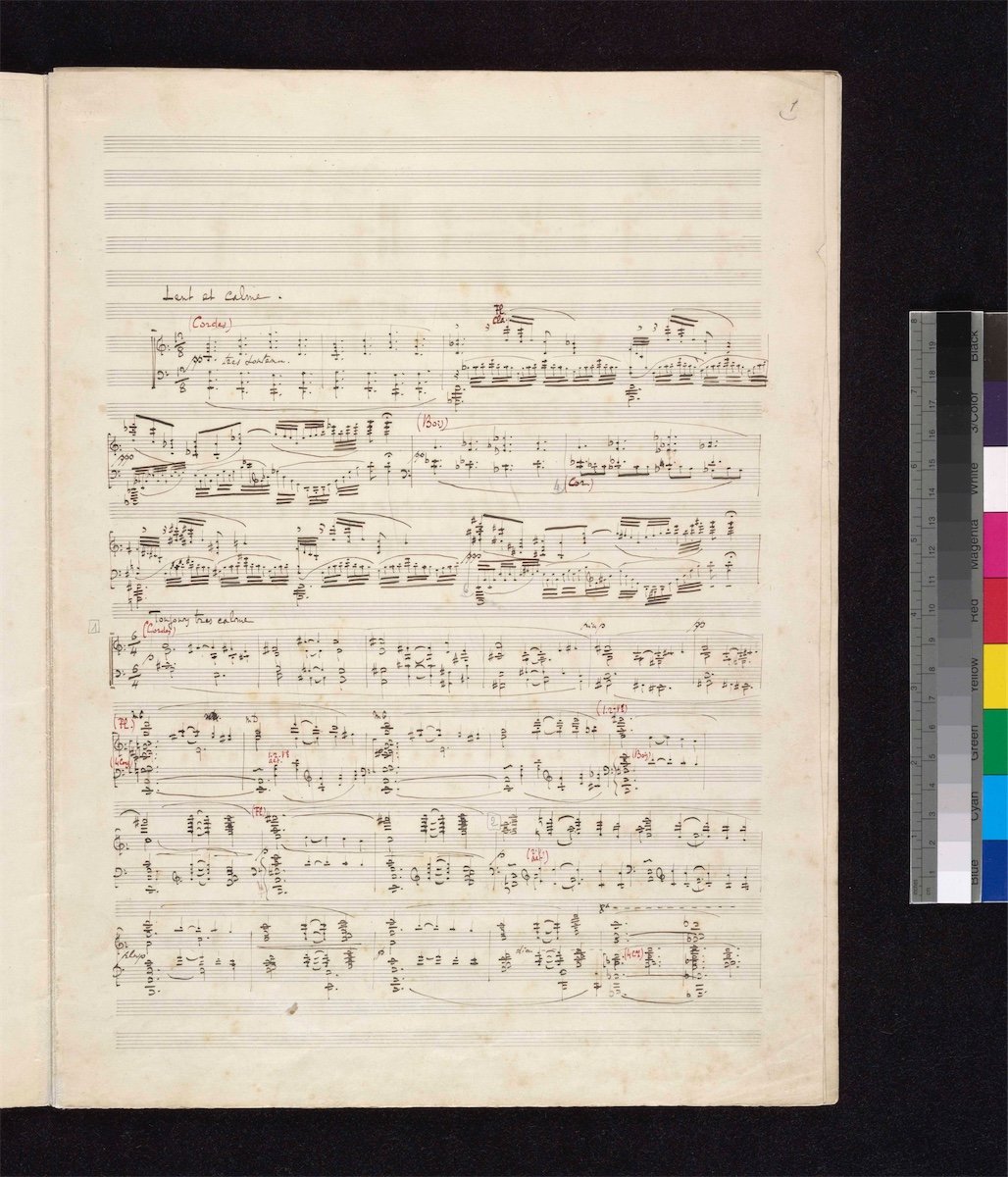
德布西珍貴美麗的手寫樂譜,實在漂亮



德布西音樂與其他領域美妙的結合
筆者非常喜愛的滑冰選手 – 金妍兒(月光)
金妍兒(夢幻曲)
Yu-na kim montage (Debussy-Reverie).
《月光》與劇場表演相結合
Clair de lune (Debussy): Alexandre Tharaud, Yoann Bourgeois – piano & dance
【補充資料】
德布西生平簡介
1999年巴倫波因的德布西紀錄片
德布西的愛與人生
【影片】德布西精彩的一生
The Life and Art of Claude Debussy – with Susan Waterfall
Links to Complete Performance 00:00 La Damoiselle Elue – Vikingur Olaffson, piano  • Debussy: La damoiselle élue, L. 62: Prélude
07:30 Trio in G Minor – Stradivari Trio • Claude Debussy – Piano Trio in G Major [Wi…
09:54 La Musique – Dawn Upshaw and James Levine, piano (from Forgotten Songs) • 08 Debussy Claude – Recueil Vasnier: Musique
16:15 C’est L’ecstase langoureuse – Dawn Upshaw and James Levine, piano (from Forgotten Songs) • Ariettes oubliées: 1. C’est l’extase lango…
18:07 La Damoiselle Elue – London Symphony and Chorus; Claudio Abbado; Ewing; Balleys • Claudio Abbado “La Damoiselle Elue” Debussy
20:27 Harmonie du Soir – Dawn Upshaw and James Levine, piano (from Forgotten Songs) • 20 Debussy Claude – Cinq poèmes de Baudela…
22:38 Original Javanese Gamelan Adalah • 影片
26:02 String Quartet – Cleveland Quartet • Cleveland Quartet – Debussy String Quartet…
29:58 Afternoon of a Faun – Oslo Philharmonic; James Gafffigan • Cleveland Quartet – Debussy String Quartet…
34:17 Pelleas and Melisande – Welsh National Opera; Boulez; Hagley; Archer • debussy: pelleas et melisande (1of2);boule…
40:20 Flute de Pan from Chansons de Bilitis – Dawn Upshaw and Gilbert Kalish • Dawn Upshaw: The complete “3 Chansons de B…
45:39 Nuages from Nocturnes for Orchestra – Vienna Philharmonic; Pierre Boulez • Debussy – Trois Nocturnes (Vienna Philharm…
53:19 Jardins Sous la Pluie – Ivan Moravec, piano • Estampes – Jardins sous la pluie
58:21 La Mer – Royal Concertgebouw; Bernard Haitink • Debussy: La mer | Bernard Haitink and the …
1:03:29 Reflets dans l’eau — Arturo Michelangeli • Debussy: Images I, CD 105: I. Reflets dans…
1:07:14 Iberia from Images for Orchestra – Les Dissonances and David Grimal • Debussy, Images for orchestra – II. Ibéria…
1:12:14 Jeux – Berlin Philharmonic; Sir Simon Rattle • Claude Debussy: «Jeux». Poème dansé pour o…
1:19:09 En Blanc et Noir – Britten and Richter • Richter and Britten play Debussy En blanc …
1:24:27 La Damoiselle Elue – Vikingur Olaffson, piano • Debussy: La damoiselle élue, L. 62: Prélude
德布西的音樂人生
Musical life of Debussy
This serene and elegant music was composed by one of the most revolutionary and original composers at the turn of the nineteenth and twentieth centuries, Claude Debussy.
這份寧靜而優雅的音樂,出自十九與二十世紀交界最具革命性與原創性的作曲家之一克勞德・德布西(Achille-Claude Debussy)。

His music is intensely honest and direct, based on the strongest and most subtle personal experiences, yet distant from the cultural practices of the past, impatient with the predictable and the obvious.
他的音樂高度真誠且直接,建立在最強烈與最細緻的個人經驗之上,同時與過往文化實踐保持距離,對於可預期或直白顯露的表現方式缺乏耐性。

Behind a mask of coolness and ironic aloofness, Debussy lived a life not contained by social categories or responsibilities.
在冷靜與帶有反諷意味的疏離外表之下,德布西以一種不被社會分類或責任羈絆的方式生活。

He lived life very personally.
他以極度個人化的方式面對生命。

The late nineteenth century was a period of dramatic and revolutionary change in all the arts.
十九世紀晚期是所有藝術領域發生劇烈與革命性改變的時代。

Debussy saw many of the artists around him in Paris discarding the classical norms that were binding them.
德布西在巴黎看到許多身邊的藝術家捨棄束縛創作的古典規範。

In an approach sometimes described as anti art, they depicted their subjects with bold splashes of color or distorted points of view.
在某種被形容為反藝術的取向下,藝術家以大膽的色彩塊面或扭曲的視角來描繪題材。

Sometimes their subject was imaginary, more like dreams than any concrete reality.
有時候,他們的題材完全來自想像,更像夢境而非具體現實。

Debussy was born into this emerging dream world in Saint-Germain-en-Laye, an idyllic place fifteen miles west of Paris, in 1862.
德布西於1862年出生於巴黎西方約十五英里的聖傑曼昂萊(Saint-Germain-en-Laye),一處帶有牧歌氣息的地區,彷彿正落在這逐漸形成的夢境世界中。

Nothing in his family background or his early childhood circumstances suggested a musical future.
他的家庭背景與早期生活中沒有任何跡象顯示他將步入音樂之路。

His father, Manuel Debussy, and his mother, Victorine, were always short of money, always changing locations and arguing endlessly.
他的父親曼紐爾・德布西(Manuel Debussy)與母親維克多琳(Victorine)長期拮据不安、居無定所,而且經常爭吵。

They named their first child Achille, after the classical hero.
他們以希臘神話英雄阿基里斯為長子取名阿希爾(Achille)。

But little Achille was melancholic and skinny.
然而小阿希爾情緒多憂且身形瘦削。

After the French were surrounded by the Prussians during the Franco-Prussian War of 1870, his mother took him to stay with one of her in-laws in Cannes, and she arranged piano lessons for him with an Italian violin teacher.
1870年普法戰爭期間,法軍遭到普魯士軍包圍時,他的母親帶著他前往坎城(Cannes)與親戚同住,並由一位義大利籍小提琴老師教授鋼琴。

When Paris became a little quieter, his father took him to study with Madame Mauté de Fleurville, who had some connection with Chopin.
當巴黎局勢稍見平靜後,父親帶他拜師於莫泰夫人(Antoinette Mauté de Fleurville),她與蕭邦(Frédéric Chopin)有一定淵源。

She told him that he would be a pianist, and he believed her.
她告訴他他將成為鋼琴家,而他也相信了她的話。

At age eight, he performed pieces by Chopin and Liszt's Fantaisie Hongroise in a public concert, although he seemed to have had no interest in being a child prodigy or public performer.
八歲時,他在公開音樂會中演奏蕭邦與李斯特(Franz Liszt)的《匈牙利幻想曲》(Fantaisie hongroise),但他似乎並無成為神童或站上舞台的渴望。

Nevertheless, he was very good.
即便如此,他的表現相當優秀。

He had a quick ear and a quick hand.
他的聽覺敏捷,手指反應亦十分迅速。

Even as a boy, he was strong-willed and withdrawn because he felt awkward socially, uncertain in his talent, and yet felt some pride from the recognition he got.
即便在童年時期,他已顯露出固執與退縮的性格,因為他在社交上感到不自在,對自己的才華尚不確定,但對外界的稱讚又感到些許驕傲。

To satisfy his aesthetic impulses, he began making beautiful scrapbooks filled with pictures and quotes.
為滿足其審美衝動,他開始收集精美圖片與詩句,整理成剪貼冊。

These were like modern sketchbooks or diaries, showing his need to internalize the world and cultivate his personal identity.
這些剪貼冊彷彿現代的素描簿或日記,展現他需要將外界世界內化並塑造自身認同。

Madame Mauté's influence and his early education as a student at the Conservatory initiated him intellectually and artistically into the Belle Époque, a time that would be seen as the golden age of France.
莫泰夫人的影響與他在巴黎音樂院(Conservatoire de Paris)的早期教育,使他在思想與藝術上踏入法國美好年代(Belle Époque),這段時期後來被視為法國的黃金年代。

This was a great time for art and literature, but the Conservatory curriculum emphasized classical training, especially for pianists and composers, and Debussy came to be impatient with its focus on mere brilliance and needlessly elaborate contrapuntal and harmonic lessons.
那是一個藝術與文學高度繁榮的時代,但音樂院課程仍強調古典訓練,特別是對鋼琴家與作曲家而言,而德布西逐漸對其中過度追求炫技、以及過於繁複的對位與和聲教學感到不耐。

Not that he didn't grasp the principles underlying the rules, but he didn't respect the rules themselves, even when he obeyed them.
並非他無法理解規則背後的原理,而是他不尊敬這些規則本身,即便他在遵從它們時亦是如此。

He said that there was really no such thing as theory, and that there were only principles, which one could master with the ear.
他曾說音樂中其實並不存在真正意義上的理論,只有原則,而這些原則可憑耳朵掌握。

The guiding template for him was pleasure.
對他而言,最重要的準則即是愉悅。

Over the next several summers, he had the non-official job of working at the Château de Chenonceau, a beautiful Renaissance château in the Loire Valley, as a kind of summer musician.
在接下來好幾個暑假裡,他被非正式地安排至羅亞爾河谷的舍農索城堡(Château de Chenonceau),以一種夏季音樂人的身分工作。

His hostess there, Madame Wilson-Pellouz, got him a much better job with Nadezhda von Meck, Tchaikovsky's patroness.
那裡的女主人威爾森・佩盧斯夫人(Madame Wilson-Pellouz)為他牽線,得到一份更好的工作,使他得以受僱於柴科夫斯基(Pyotr Ilyich Tchaikovsky)的資助者馮・梅克夫人(Nadezhda von Meck)。

Von Meck took great interest in the seventeen-year-old Debussy, who although not particularly handsome, had a high forehead, good cheekbones and delicate features.
馮・梅克夫人對當時十七歲的德布西十分感興趣,他雖然稱不上英俊,卻有高聳的前額、明顯的顴骨以及細緻的臉部輪廓。

Debussy had a humorous side also, when he let down his guard.
當德布西卸下心防時,他也會展現幽默的一面。

He accompanied von Meck and her children to various stages of the Russian countryside to give piano lessons to her children.
他陪伴馮・梅克夫人及其子女前往俄羅斯鄉間不同地點,為孩子們教授鋼琴。

He absorbed everything he heard in the performances of the second piano concerto by Tchaikovsky.
他從柴科夫斯基第二號鋼琴協奏曲的演奏之中吸收並學習他所聽到的一切。

He was always curious and hungry for knowledge, but had given no thought to his future life's work.
他始終保有好奇心與求知慾,但當時仍未思考過自己未來的職志。

Returning to Paris, Debussy lived alone and worked as a vocal accompanist.
回到巴黎後,德布西獨自生活,並擔任聲樂伴奏工作。

Being a répétiteur brought him into the theatrical world, and in that world, one night he met a woman who would become one of the great passions of his life, Marie Vasnier.
這份排練鋼琴師的工作使他進入劇院世界,而在那個世界中,他某晚結識了對他生命有重大影響的女性瑪莉・瓦斯涅(Marie Vasnier)。

Marie Vasnier was not only very beautiful, she was also an unusually gifted amateur soprano.
瑪莉・瓦斯涅不僅非常美麗,還是一位極具天賦的業餘女高音歌者。

Her husband, Henri Vasnier, was a much older bureaucrat who was educated and refined.
她的丈夫亞納桑・瓦斯涅(Henri Vasnier)年紀較長,是一位受過良好教育且舉止文雅的公務人員。

Henri Vasnier was the one who supported the talented young composer, and Marie inspired many of Debussy's early songs.
支持這位年輕作曲家的是亞納桑,而瑪莉則啟發了德布西許多早期藝術歌曲的創作。

The relationship with Marie never had a future, as it was clearly an impossible, long-term romance.
他與瑪莉之間的感情顯然不可能發展成長期關係,這段愛戀注定沒有未來。

She treated him tenderly, but never seems to have reciprocated Debussy's adoration, and Debussy remained maddeningly jealous for years.
她以溫柔友善的態度對待他,然而似乎從未回應德布西的熱烈愛慕,而德布西在多年期間始終陷於折磨人的嫉妒心情中。

During this time, Debussy wrote incessantly, especially vocal music, creating melodies filled with longing, volatility, and willfulness, songs that were to become legendary in modern music.
在這段時間裡,德布西不停創作,特別是聲樂作品,他寫出充滿渴望、不安與任性的旋律,而這些歌曲後來成為現代音樂史上的重要作品。

In 1884, Debussy competed for the Prix de Rome, France’s most coveted musical prize, and won with his cantata "The Prodigal Son (L’enfant prodigue)".
1884年,德布西參加法國最受矚目的音樂獎項羅馬大獎(Prix de Rome),並以其清唱劇《浪子》(L’enfant prodigue)獲得首獎。

The prize enabled him to live and work at the Villa Medici in Rome, along with other young musicians and artists.
這項獎助使他得以與其他年輕音樂家與藝術家一起,居住於羅馬的美第奇別墅(Villa Medici)進行創作。

During his stay in Rome, Debussy's imagination was stimulated by poetry and literature.
在羅馬期間,德布西的想像力受到詩歌與文學的強烈刺激。

He especially admired the poetry of Charles Baudelaire and Paul Verlaine.
他特別推崇夏爾・波特萊爾(Charles Baudelaire)與保羅・魏爾倫(Paul Verlaine)的詩作。

These poets believed that their subjects couldn't be rendered directly, but should be suggested with images, rhythms and sounds of words withheld.
這些詩人相信他們的主題不能直接呈現,而應透過意象、節奏與隱含語句的聲響來加以暗示。

Debussy really liked this idea.
德布西對此觀念十分欣賞。

Music could be sensitive to nuance, without any need to explain.
音樂可以對細微差異保持敏銳,而無須解釋。

However, his prize came with stipulations, including the rule that all his work was supervised by the academy.
然而,這個獎項有相應規定,包括所有創作皆須由學院監督。

Debussy tried to avoid the unfashionable classical plots and radically emotional stories required in the cantatas he was obliged to write, but failed in them, producing pieces like the banal "Spring (Printemps)" that he would later reject as a bad early work.
德布西嘗試迴避學院要求在清唱劇中使用過時的古典劇情與過度激昂的情感故事,但未能成功,因此寫出如《春》(Printemps)這般平庸的作品,後來他否定這些早期作品的價值。

Even though he was in Rome, his heart and imagination were in Paris.
縱然身在羅馬,他的心與想像仍留在巴黎。

He especially missed Marie Vasnier, whom he considered his muse and first love.
他尤其思念瑪莉・瓦斯涅,他視她為自己的繆思與初戀。

Letters to Marie expressed his intense yearning for her and his jealousy of her husband Henri.
他寫給瑪莉的信中充滿對她的強烈思念與對其丈夫亞納桑的嫉妒。

It is important to note that his relationship with Marie had boundaries: she was married, and he understood that the connection would never come true.
值得注意的是,他與瑪莉的關係總有限制,她已有婚姻,而他也明白這段情感不可能實現。

Nonetheless, Marie remained an essential part of Debussy's emotional and creative landscape.
然而,瑪莉始終是德布西情感與創作世界中的關鍵存在。

Debussy returned from Rome in 1887, and soon became absorbed in the fashionable world of Paris together with his friend Erik Satie.
1887年,德布西從羅馬返回後,很快便與好友艾瑞克・薩替(Erik Satie)一同融入巴黎的時尚生活圈中。

Debussy visited all the major art exhibits and concerts and especially the new experimental opera being performed at the Opéra-Comique.
德布西參觀主要藝術展覽與音樂會,特別是前往喜歌劇院(Opéra-Comique)觀賞正在上演的前衛實驗歌劇。

He sought out literary salons with intellectual and sensual poetry readings and presentations of new piano pieces.
他經常前往文學沙龍,參與富含思想與感官刺激的詩歌朗誦,以及新鋼琴作品的發表。

For a young and fully alive composer, this was the place to be.
對於一位年輕而對生活充滿熱情的作曲家而言,這裡正是他嚮往之地。

In 1889, he heard for the first time the gamelan music of Indonesia at the Paris Exposition and was fascinated by the bell-like sonorities and repeating patterns.
1889年,他在巴黎世界博覽會中首次聽見來自印尼的加美蘭(Gamelan)音樂,被其鐘鈴般的音色與重複音型深深吸引。

The layered percussion, the gentle metallic instruments, the sinuous rhythm of hindustani singers: all these sounds entered into his imagination and gave him new ideas about orchestration and form.
多層次的敲擊聲響、輕柔金屬質地的樂器、印度斯坦(Hindustani)歌者蜿蜒的節奏,這些聲響全都進入他的想像空間,為他帶來新的配器與形式概念。

Debussy also listened to Russian music, such as Rimsky-Korsakov and Mussorgsky, whose harmonies and independent use of scales such as the whole-tone scale gave him new insights into what music could be.
德布西同時接觸俄國音樂,例如尼古拉・里姆斯基-柯薩科夫(Nikolai Rimsky-Korsakov)與莫傑斯特・穆索爾斯基(Modest Mussorgsky)的作品,他們的和聲語法與全音音階等素材的獨立運用,使他對音樂本質有全新的理解。

Through these influences he was beginning to shape his own original voice.
在這些影響之下,他開始逐漸形成自己獨特的音樂語言。

By 1890, Debussy's attitude toward the classical musical rules he learned at the academy was dissolving.
到了1890年,德布西對學院所傳授的古典音樂規範已逐漸鬆動。

He no longer wished to write symphonies and operas that explained their emotional content too directly.
他不再希望創作那種將情感過度直白表達的交響曲或歌劇。

He wanted sound itself to suggest meaning through subtle nuances and atmosphere.
他希望透過聲響本身,以細微變化與氛圍生成意義。

He wished to free himself from traditional forms and instead embrace changes of tempo, color and harmony that would create a feeling of suspended time.
他希望擺脫傳統曲式,而以速度、音色與和聲的變化來營造時間被懸置般的感受。

He sought the sounds that would reveal the hidden currents that he believed flowed underneath the surface of life.
他追尋那些能展現生命表層之下潛藏脈動的聲響。

Poetry and imagination would be uppermost.
詩意與想像將成為最重要的核心。

He wrote: "I wanted music to have the freedom that one finds in painting, where feeling is expressed in a thousand different shades and where rhythm is a thing fluid and divine."
他寫道:「我希望音樂擁有如繪畫般的自由,使情感得以透過成千上萬種色彩表現,並使節奏成為一種流動而神聖的事物。」

Debussy became a part of the Symbolist movement in Paris, an aesthetic philosophy shared by the poets Charles Baudelaire, Paul Verlaine and Stéphane Mallarmé.
德布西成為巴黎象徵主義(Symbolism)的一份子,這種美學理念是由詩人夏爾・波特萊爾(Charles Baudelaire)、保羅・魏爾倫(Paul Verlaine)與史蒂芬・馬拉美(Stéphane Mallarmé)共同推動。

Symbolists believed in suggestion rather than direct description.
象徵主義者相信應以暗示取代直接描述。

There can be a power in vagueness, in leaving things unsaid and partially revealed.
他們認為模糊與未盡揭露之間蘊含力量。

The music that Debussy was developing better suited the refined, sensual and abstract qualities that the Symbolists held dear.
德布西正在醞釀的音樂語言,更適合象徵主義所珍視的細緻、感官與抽象特質。

Music would not explain.
音樂不需要解說。

It would reveal.
它將展現事物。

Debussy was beginning to understand that music could evoke without naming, that it could reveal inner sensations without describing them literally.
德布西開始理解音樂能夠引發感受而不需指名,能夠揭示內在感覺而無須以字面方式描述。

This idea would guide his music throughout his life.
這個理念將貫穿他一生的創作。

In 1892, Debussy began work on an opera based on Maurice Maeterlinck’s play “Pelléas et Mélisande”.
1892年,德布西開始投入創作一部以莫理斯・梅特林克(Maurice Maeterlinck)的劇作《佩雷亞斯與梅麗桑德》(Pelléas et Mélisande)為題材的歌劇。

The story is mysterious, filled with suggestion and ambiguity, and Debussy sought to match the play's atmosphere with equally subtle music.
這則故事充滿神秘感與暗示性,帶有模糊與不確定性,而德布西試圖以同樣細膩的音樂語氣回應劇本的氛圍。

He avoided the grand arias and overt emotional display typical of 19th century opera, instead setting the speech rhythms of the French language to music, creating a naturalistic kind of sung conversation.
他避開十九世紀歌劇中常見的華麗詠嘆與外放情緒,改以前所未有的方式,以法語語調直接融入音樂,使歌唱如日常對話般自然。

In 1894, Debussy had his first major success with “Prelude to the Afternoon of a Faun (Prélude à l’après-midi d’un faune)”, inspired by a poem of Stéphane Mallarmé.
1894年,德布西以《牧神午後前奏曲》(Prélude à l’après-midi d’un faune)首次獲得重要成功,此曲靈感來自史蒂芬・馬拉美(Stéphane Mallarmé)的同名詩作。

This orchestral work opens with one of the most famous flute melodies in music history, a sinuous phrase that seems to dissolve traditional tonality.
這首管弦樂作品以音樂史上最著名的長笛旋律之一作為開端,曲線蜿蜒的聲線彷彿使傳統調性逐漸消解。

The piece created a new musical world, one that was fluid, suggestive and sensuous.
此曲開展了一個嶄新的音樂世界,呈現出流動、暗示與細緻感官性的特質。

This work helped establish Debussy’s reputation as a revolutionary composer.
這部作品奠定了德布西身為革新作曲家的聲望。

The success of “Prelude to the Afternoon of a Faun” encouraged Debussy to complete “Pelléas et Mélisande”, which premiered in 1902 after a long and difficult preparation.
《牧神午後前奏曲》的成功使德布西更有信心完成《佩雷亞斯與梅麗桑德》,此作歷經漫長且艱辛的準備後,於1902年首演。

The opera shocked many listeners, but others found its delicacy and truth deeply moving.
這部歌劇令許多聽眾感到震驚,但也有人被其細膩與真誠深深打動。

Debussy now turned to creating a new kind of piano music.
德布西開始致力於創作一種全新的鋼琴音樂。

He wanted the piano to sound less percussive, more like a watercolor painting, with harmonies that shimmered and dissolved like light on water.
他希望鋼琴的聲響不再是一種敲擊性的樂器,而更像水彩畫般,和聲能如水面上的光影般閃爍與消散。

His first book of “Nocturnes,” written for orchestra, explored various colors of night: clouds drifting in the sky, the sound of waves in the sea, the mystery of the moon.
他的《夜曲》(Nocturnes)第一冊為管弦樂作品,探索夜色中不同的音響色彩,例如天空中飄動的雲、海浪的聲響,以及月色的神秘氛圍。

In these pieces, Debussy moved away from traditional harmonic progressions and instead focused on chord colors and modal shades.
在這些作品中,德布西不再依賴傳統和聲進行,而是專注於和弦色彩與調式細部變化。

He was also inspired by the adventurous harmonic language of Richard Wagner, yet he chose to reject Wagner’s overwhelming drama and heavy emotional intensity.
他同時受到理查・華格納(Richard Wagner)大膽和聲語言的啟發,但他刻意拒絕華格納過度戲劇化與情緒強烈的氛圍。

Debussy wrote: “Wagner was a beautiful sunset mistaken for a dawn.”
德布西曾寫下:「華格納是一道被誤認為黎明的美麗夕陽。」

He wanted to move onward instead of backward.
他希望前進,而非回到過去。

Around this time, Debussy’s unconventional personal life also began to draw attention.
在這段時期,德布西不尋常的私人生活亦開始受到關注。

He ended his relationship with Marie Vasnier and became involved with a young woman named Gabrielle Dupont.
他結束與瑪莉・瓦斯涅(Marie Vasnier)的關係,並與一位名為加布里埃爾・杜邦(Gabrielle Dupont)的年輕女子交往。

Their relationship was passionate, but often stormy, and marked by Debussy’s restlessness and frequent absences.
他們的關係充滿熱情,然而動盪不安,德布西常因浮躁與頻繁缺席而使這段感情陷入困擾。

Despite the personal chaos, Debussy’s musical imagination continued to expand.
儘管個人生活混亂,德布西的音樂想像仍不斷擴展。

In 1903, Debussy married a woman named Lily Texier, but the marriage was troubled from the start.
1903年,德布西與莉莉・特謝(Lily Texier)結婚,但婚姻一開始便充滿問題。

Debussy was often unhappy and soon became involved with another woman, Emma Bardac, who was cultured, intelligent and more compatible with his artistic life.
德布西經常感到不快,且很快便與另一位女子艾瑪・巴達克(Emma Bardac)發展關係,她受過良好教育、聰慧,且更能與他的藝術生活契合。

Emma had previously been the lover of Gabriel Fauré, and she understood the artistic world that Debussy inhabited.
艾瑪先前曾是加布里埃爾・佛瑞(Gabriel Fauré)的戀人,她熟悉德布西所處的藝術圈。

Debussy left Lily to live with Emma, and the scandal shocked Parisian society.
德布西為了與艾瑪同居而離開莉莉,這樁醜聞震驚巴黎社交界。

Lily attempted suicide in despair, which caused many of Debussy’s friends to turn away from him.
莉莉因為絕望而試圖自殺,使得德布西失去許多朋友的支持。

Despite the turmoil, Debussy and Emma remained together and eventually married.
儘管風波不斷,德布西最終仍與艾瑪在一起並正式結婚。

In 1905, their daughter Claude-Emma was born, and Debussy adored her.
1905年,他們的女兒克洛德・艾瑪(Claude-Emma)出生,德布西非常疼愛她。

He called her by her nickname “Chouchou”.
他為她取了暱稱「Chouchou」。

She became a source of joy and tender inspiration for him during a period that was otherwise full of struggles.
在充滿困難的時期,小 Chouchou 成為他的喜悅與柔情靈感來源。

Around this time, Debussy moved with Emma and Chouchou into an apartment near the Bois de Boulogne, where he could work in peace.
在此期間,德布西與艾瑪和 Chouchou 一起搬到巴黎布洛涅森林(Bois de Boulogne)附近的住處,使他能在較為安靜的環境中創作。

He continued developing his distinctive orchestral palette and approach to form, exploring a world of suggestion rather than statement.
他持續發展獨特的管弦語彙與形式理念,探索以暗示取代陳述的音樂世界。

Debussy’s artistic ideals were now clear, and he continued to pursue new pathways in harmony and texture.
德布西的藝術理念至此已趨明確,他持續追尋和聲與音色上的新方向。

He wanted his music to reflect what he called “the mysterious correspondences between Nature and Imagination”.
他希望自己的音樂能反映出他所稱的「自然與想像之間的神秘關聯」。

He sought to express the inner life of things, rather than their outward appearance.
他試圖表現事物的內在生命,而非其外在形式。

He wrote piano works like “Estampes”, “Images” and the first book of “Préludes”, each piece a miniature scene filled with shifting colors.
他創作《版畫》(Estampes)、《映像》(Images)與《前奏曲集》第一冊(Préludes, Book I)等鋼琴作品,每首皆如一幅色彩不斷變化的微型場景。

Pieces such as “Water Reflections (Reflets dans l’eau)” evoke light shimmering on the surface of a river, yet do so without describing the scene literally.
其中如《水之映像》(Reflets dans l’eau)這樣的作品,在未直接描繪景象的情況下,仍能喚起河面上光影微動的感受。

He also wrote orchestral works such as “La Mer”, a portrait of the sea, which reveals its many moods.
他亦創作管弦樂作品《大海》(La Mer),以音樂描繪海洋千變萬化的情緒樣貌。

Debussy wrote: “Music is the space between the notes.”
德布西曾寫道:「音樂存在於音符之間的空間。」

He believed that silence and resonance were as meaningful as sound itself.
他認為沉寂與迴響與聲音本身一樣具有意義。

The critics often did not understand his work, but audiences increasingly appreciated the beauty and innovation he brought to music.
評論界時常不理解他的作品,但聽眾對他所帶來的美感與創新日益欣賞。

Debussy had become a leader of modern French music.
德布西已成為法國現代音樂的領軍人物。

However, Debussy’s life was not free of difficulties.
然而,德布西的人生並非沒有困難。

He struggled financially, often relying on advances from publishers and help from friends.
他時常面臨經濟壓力,經常依賴出版社的預付稿費與友人資助。

He felt the burden of expectations and the pressure to constantly innovate.
他感受到外界期待與持續創新的壓力。

Debussy also experienced declining health, suffering from stomach pain and other ailments that would later intensify.
德布西開始面臨健康衰退,飽受胃痛與其他病症之苦,而這些問題在後來愈加嚴重。

Yet despite setbacks, he worked with determination.
儘管遭遇種種阻礙,他仍堅定不懈地創作。

He composed the opera “The Martyrdom of Saint Sebastian (Le Martyre de saint Sébastien)” in 1911, a theatrical work with mystical religious themes.
他於1911年完成劇場作品《聖賽巴斯汀殉難》(Le Martyre de saint Sébastien),此作帶有神祕宗教題材。

His ballet “Jeux”, composed in 1913, featured new rhythmic ideas and an ethereal orchestral palette.
他於1913年創作的芭蕾舞作《遊戲》(Jeux),呈現新的節奏概念與輕盈飄逸的管弦色彩。

Debussy’s music continued to redefine what harmony and form could be.
德布西的音樂持續重新界定和聲與曲式的可能性。

He refused to be confined by any school or label.
他拒絕被任何學派或標籤所侷限。

He wrote: “There is no theory. You simply have to listen. Pleasure is the law.”
他寫道:「沒有什麼理論,你只需聆聽。愉悅就是法則。」

Debussy’s belief in freedom of expression remained central to his art.
自由表現的理念始終是德布西藝術的核心。

The outbreak of World War I in 1914 brought fear and uncertainty to France, and Debussy felt this strain deeply.
1914年第一次世界大戰爆發,為法國帶來恐懼與不確定性,德布西深受其壓力所影響。

Although sick and often depressed, he wrote several works in support of the French war effort.
儘管受病痛與憂鬱折磨,他仍創作多部作品以支持法國的戰爭努力。

These included pieces for piano such as “The Sunken Cathedral (La cathédrale engloutie)” and “Canope”, which reflect a somber and introspective mood.
其中包括鋼琴作品《沉沒的教堂》(La cathédrale engloutie)與《卡諾佩》(Canope),呈現沈鬱且內省的氣氛。

Debussy believed that music could provide consolation and strength during dark times.
德布西相信音樂能在黑暗時期提供慰藉與力量。

He wrote: “Art is the most beautiful of all lies.”
他寫道:「藝術是所有謊言中最美的一種。」

Debussy’s nationalism was quiet rather than loud, expressed through refinement rather than spectacle.
德布西的民族情感是內斂的,以細膩而非宏大姿態展現。

By the end of his life, he remained convinced that French music must develop its own identity, independent from German influences.
即使到了生命終點,他仍堅信法國音樂必須建立自身的獨立特質,不被德國影響所左右。

In 1915, he began composing a set of instrumental sonatas, intending to write six as a tribute to French tradition.
1915年,他開始創作一套器樂奏鳴曲系列,原計畫寫六首,以向法國的傳統致意。

He completed only three before his illness worsened: the “Cello Sonata”, the “Violin Sonata”, and the “Sonata for Flute, Viola and Harp”.
然而在病情惡化前,他僅完成三首作品,即《大提琴奏鳴曲》(Cello Sonata)、《小提琴奏鳴曲》(Violin Sonata)與《長笛、中提琴與豎琴奏鳴曲》(Sonata for Flute, Viola and Harp)。

These late pieces show a new clarity, economy, and concentrated expressivity.
這些晚期作品展現出全新的明晰、精練與高度凝聚的表現力。

They are among Debussy’s final statements in his lifelong search for new musical possibilities.
它們是德布西在追尋音樂新可能之終身旅程中的最終語句之一。

Debussy died in Paris on March 25, 1918, during a German bombing raid, as World War I continued to rage.
1918年3月25日,當第一次世界大戰仍持續期間,德布西於德軍砲轟下在巴黎逝世。

He was buried quietly, without national ceremony, because of the wartime conditions.
由於戰時情況,他的安葬程序十分低調,未舉行全國性儀式。

Although his funeral was modest, his legacy would soon be celebrated around the world.
儘管葬禮樸素無華,他的音樂遺產很快便在全世界受到推崇。

Debussy left behind a body of work that transformed the language of music and opened new pathways for generations of composers to come.
德布西留下的作品徹底改變了音樂語言,並為後世作曲家開拓出嶄新的方向。
Part.2 克洛德・德布西(Claude Debussy)的音樂語言
The Musical Language of Claude Debussy
Debussy’s music is defined by its unique approach to harmony.
德布西的音樂以其獨特的和聲處理為重要特徵。

Traditional harmony seeks to direct the listener along a path of tension and release, moving toward a clearly defined cadence.
傳統和聲旨在引導聽者沿著緊張與舒緩的路徑前進,最終抵達明確的終止和聲。

Debussy preferred a different approach, in which harmony could exist for its own sake as a sound color rather than a function.
德布西則採取不同方式,將和聲視為獨立的聲響色彩,而非僅具有功能性的推進作用。

He often used chords that did not lead anywhere, creating a sensation of suspension.
他經常使用不具導向性的和弦,使音樂呈現懸置感。

These include whole-tone scales, pentatonic scales, modal inflections and parallel chord movements.
這些語彙包含全音音階、五聲音階、調式轉變以及平行和弦進行。

Instead of the goal-oriented harmonic progressions used in German music such as Wagner, Debussy’s harmonies frequently hover in one place.
與華格納(Richard Wagner)等德國音樂採用目標導向的和聲邏輯不同,德布西的和聲經常停留於同一位置。

His music encourages the listener to dwell in the moment rather than anticipate what comes next.
他的音樂鼓勵聆聽者停留於當下,而非期待接下來的發展。

Melody in Debussy’s works is often fluid and fragmented, avoiding symmetrical phrases.
德布西作品中的旋律常呈現流動且片段化的樣貌,避免對稱樂句。

He drew inspiration from French speech patterns, allowing melody to follow natural rhythms of language.
他從法語語調獲得靈感,使旋律順應語言自然的節奏。

Orchestration is central to Debussy’s sound world, treated not merely as support but as a primary expressive element.
配器是德布西音響語彙的核心,不僅用於伴奏,而是主要表現手段。

He used specific combinations of instruments to produce new timbres that had not been heard before.
他透過特定的樂器組合,創造前所未見的音色。

His writing for flute, oboe, harp and muted strings became characteristic of his style.
他為長笛、雙簧管、豎琴與弱音弦樂所設計的聲響,成為其風格的重要標記。

Debussy sought to reveal the essence of sound itself.
德布西旨在展現聲響本身的本質。

He once said that music was “a dream from which one must not wake”.
他曾說音樂是「一場不應被喚醒的夢」。

His goal was not to tell a story through music, but to allow sound to evoke inner sensations and images.
他的目標並非透過音樂敘述故事,而是讓聲音喚起內在感受與意象。

His approach opened new directions for twentieth-century composers, influencing figures such as Maurice Ravel and Igor Stravinsky.
他的理念為二十世紀作曲開啟新方向,影響包括莫里斯・拉威爾(Maurice Ravel)與伊戈爾・史特拉汶斯基(Igor Stravinsky)等人。

Debussy’s music often suggests the presence of water, wind or shifting light, but he does not directly imitate nature.
德布西的音樂時常暗示水、風或光影變化的存在,但並未直接模仿自然現象。

Instead, he aims to evoke the sensation of experiencing nature.
相反地,他旨在喚起人們感受自然的體驗。

This distinction reflects his belief that art should reveal the essence of things rather than depict their outer forms.
這種差異反映出他相信藝術應展現事物的本質,而非描繪外在形象。

Rhythm in Debussy’s works is often flexible and irregular, avoiding mechanical repetition.
德布西作品中的節奏常具有彈性且不規則,避免機械式重複。

His music frequently uses subtle tempo fluctuations to create a sense of fluid motion.
他的音樂經常透過細微速度變化,形成流動感。

Dissonance in his music does not always resolve, instead existing as part of the sonority.
在他的音樂中,不協和音並不一定導向解決,而是作為聲響的一部分存在。

This expands the expressive possibilities of harmony beyond the rules of classical tonality.
此舉使和聲表現超越古典調性規範的限制。

Debussy rejected the notion that music must develop through conflict and resolution.
德布西否定音樂必須依靠衝突與解決推展的觀念。

Rather than dramatic progression, he preferred musical ideas that unfold gradually.
他偏好逐漸展開的音樂想法,而非戲劇性的推進。

This approach led critics to describe his music as vague or formless, while supporters praised its refinement and originality.
這種方式使批評者視其音樂為模糊或不具形式,但支持者則讚揚其細緻與創新。

Debussy’s piano writing explores the full range of resonance available to the instrument.
德布西的鋼琴寫作探索鋼琴可展現的完整共鳴範圍。

He used the sustain pedal to create blurred harmonies and overlapping sonorities.
他運用延音踏板形成模糊和聲與重疊聲響。

He also incorporated new finger techniques to achieve effects similar to harp or percussion instruments.
他亦採用新的指法技巧,以達成接近豎琴或敲擊樂般的效果。

The result is music that invites the listener to perceive sound in new ways.
因此,他的音樂引導聽者以新的方式感受聲響。

Debussy was also influenced by non-Western musical traditions.
德布西同樣受到西方音樂以外傳統的影響。

The gamelan ensembles he heard at the 1889 Paris Exposition revealed to him a musical language based on timbre and pattern rather than harmony.
他在1889年巴黎世界博覽會中聽到的加美蘭(Gamelan)合奏,向他展現了一種以音色與音型為基礎、而非和聲推進的音樂語言。

This encounter led him to explore layered textures and repeating figures in his own works.
這次接觸促使他在作品中探索多層次音響與重複音型的運用。

He was also intrigued by Spanish and Middle Eastern musical idioms, which he incorporated into pieces such as “La soirée dans Grenade” and sections of “Ibéria”.
他亦對西班牙與中東音樂語彙深感興趣,並將其融入《格拉那達的黃昏》(La soirée dans Grenade)及《伊比利亞》(Ibéria)部分段落中。

Debussy admired the emotional directness and modal harmony of Russian composers, particularly Mussorgsky and Rimsky-Korsakov.
德布西欽賞俄國作曲家的情感直接性與調式和聲,尤其是莫傑斯特・穆索爾斯基(Modest Mussorgsky)與尼古拉・里姆斯基-柯薩科夫(Nikolai Rimsky-Korsakov)。

These diverse influences helped him create a personal voice that could not be defined by a single style or tradition.
這些多元影響協助他形成無法被單一風格或傳統界定的個人語言。

Debussy avoided academic counterpoint when it interfered with clarity or atmosphere.
當學院式對位妨礙音響明晰或氛圍呈現時,德布西傾向避免使用。

He favored transparent textures that allow each voice to be perceived within the whole.
他偏好能使每條聲部在整體中清楚辨識的透明音響結構。

His use of orchestral color became one of the defining markers of twentieth-century composition.
他對管弦音色的運用,成為二十世紀音樂創作的重要指標之一。

Critics often debated whether his music belonged to impressionism, a term borrowed from visual art.
評論者時常爭論他的音樂是否應被歸為「印象主義」,此術語源自視覺藝術領域。

Debussy himself rejected this label, insisting that music should not be tied too closely to painting or narrative.
德布西本人拒絕此稱呼,主張音樂不應過度依附於繪畫或敘事。

He argued that music possesses its own laws and expressive powers.
他認為音樂擁有自身的法則與表現能力。

Nonetheless, the term impressionism continues to be widely used to describe the atmospheric qualities and innovative harmonies of his works.
然而,「印象主義」一詞仍被廣泛使用,以描述其作品中的氛圍特質與創新的和聲語法。

Debussy believed that music should appeal directly to the senses.
德布西相信音樂應直接訴諸感官。

He felt that beauty in music arises not from strict form but from subtle gradations of sound.
他認為音樂之美並非來自嚴格曲式,而源於聲響層次的細緻變化。

He sought to compose pieces in which sound unfolds organically, rather than being forced into traditional structures.
他致力於創作使聲響自然展開的作品,而非被迫符合傳統框架。

His forms often resemble mosaics of short ideas rather than long, goal-oriented developments.
他的作品形式常由短小想法組合而成,而非以目標導向方式長篇推展。

This reflects his belief in musical freedom and fluid design.
這反映他對音樂自由與流動設計的信念。

Debussy was fascinated by the concept of timbre as an independent musical element.
德布西著迷於將音色視為獨立音樂元素的概念。

For him, tone color could suggest meaning just as effectively as melody or harmony.
對他而言,音色與旋律或和聲一樣能有效呈現意涵。

He expanded the role of traditionally secondary instruments, such as the harp, celesta and muted strings.
他擴大過往較為次要的樂器角色,例如豎琴、鋼片琴(celesta)與弱音弦樂。

He explored delicate balances between instrumental groups to create shimmering surfaces of sound.
他透過樂器群間的細緻平衡,形塑閃耀般的音響表面。

Debussy’s achievements helped redefine the orchestra for the twentieth century.
德布西的成就協助重新定義二十世紀的管弦樂。

His innovations influenced composers such as Maurice Ravel, Béla Bartók and Olivier Messiaen.
他的創新影響莫里斯・拉威爾(Maurice Ravel)、貝拉・巴托克(Béla Bartók)與奧利維耶・梅湘(Olivier Messiaen)等作曲家。

Through Debussy, music began to embrace a wider palette of timbres, rhythms and harmonic possibilities.
透過德布西,音樂開始接納更廣泛的音色、節奏與和聲可能性。

He opened doors that would lead future composers toward entirely new sound worlds.
他開啟通往全新音響世界的大門,供後世作曲家探索。

Debussy’s music often blurs the line between consonance and dissonance, treating both as equal components of sound.
德布西的音樂常模糊協和與不協和的界線,將兩者視為聲響中同等重要的成分。

He used unresolved sonorities to prolong moments of tension or wonder.
他透過未解決的聲響延長張力或驚奇的時刻。

Traditional tonal rules no longer dictated the direction of his music.
傳統調性法則不再支配他的音樂前進。

This gave listeners the sense of floating in an atmosphere rather than moving toward a fixed destination.
這使聆聽者如同漂浮在音響氛圍中,而非朝固定終點前進。

Debussy’s melodies often avoid clear climaxes, instead traveling in gentle curves.
德布西的旋律常避開明確高潮,而是以緩和曲線前進。

This approach reflects his belief that music should preserve a natural and fluid shape.
這種方式反映他相信音樂應保有自然與流動的形態。

His works frequently use subtle orchestral colors to evoke moods that cannot be precisely named.
他的作品經常以細膩的管弦色彩喚起難以明確命名的情緒。

For Debussy, ambiguity was not a weakness but a resource for expressive depth.
對德布西而言,模糊並非弱點,而是提升表現深度的資源。

He felt that music could represent experiences beyond the reach of words.
他認為音樂能表現語言難以企及的體驗。

Listeners are encouraged to feel rather than analyze his music.
他的音樂鼓勵聆聽者以感受為先,而非著重分析。

Critics sometimes accused him of neglecting structure, but his structures simply followed different principles.
評論者有時指責他忽略結構,但他的結構僅是遵循不同的原則。

Debussy’s forms emerge through layers of timbre and subtle thematic transformation.
德布西的曲式透過音色層次與主題細微變化逐步展開。

His music emphasizes detail and atmosphere rather than grand architectural design.
他的音樂強調細節與氛圍,而非宏大的建築式規劃。

Debussy often compared music to the visual arts, particularly painting.
德布西經常將音樂與視覺藝術,尤其是繪畫進行比較。

He admired artists who used color and light to create mood rather than to depict precise objects.
他欣賞那些運用色彩與光線來營造氛圍,而非描繪精確物象的藝術家。

Claude Monet’s paintings, with their attention to shimmering detail and shifting perception, paralleled Debussy’s own aesthetic concerns.
克洛德・莫內(Claude Monet)的作品,注重光影細節的閃耀與視覺感知的變化,與德布西自身的美學關懷相互呼應。

Debussy, however, insisted that music must remain independent, even while sharing certain qualities with art.
然而,德布西堅持音樂必須保持獨立性,即便它與藝術其他領域共享某些特質。

He believed music operates through sound alone, without the need for literal representation.
他相信音樂僅透過聲響運作,而無需字面再現。

He rejected the idea that music should imitate visual images.
他否定音樂應模仿視覺意象的觀念。

Instead, he argued that music can illuminate emotions and sensations that cannot be seen.
相反地,他認為音樂能揭示那些無法被看見的情緒與感受。

This belief shaped his entire compositional output.
這種信念塑造了他全數的創作成果。

Debussy also drew inspiration from literature, particularly from Symbolist poets like Stéphane Mallarmé and Paul Verlaine.
德布西亦從文學中汲取靈感,尤其來自象徵主義詩人史蒂芬・馬拉美(Stéphane Mallarmé)與保羅・魏爾倫(Paul Verlaine)。

He felt that their emphasis on nuance and suggestion closely matched the goals of music.
他認為他們對細微差異與暗示性的追求,與音樂的目標高度一致。

He cited poetic imagery as a guide for shaping musical phrases.
他視詩意意象為塑造音樂樂句的重要依據。

His interest in symbolist drama led him to works like “Pelléas et Mélisande”.
他對象徵主義戲劇的興趣,使他走向《佩雷亞斯與梅麗桑德》(Pelléas et Mélisande)等作品。

Debussy believed that opera should follow the rhythms of speech rather than impose artificial melodic structures.
德布西相信歌劇應遵循語言的節奏,而非強加人工式的旋律架構。

His vocal lines often resemble elevated speech set against atmospheric orchestration.
他的聲樂線條常如升華的語言,置於富有氛圍感的管弦伴奏之上。

Debussy’s views on orchestration went beyond simply assigning notes to instruments.
德布西對配器的看法遠超過為樂器分配音符的層次。

He treated the orchestra as a palette of colors that could be blended, layered or isolated for expressive effect.
他將管弦樂團視為可混合、堆疊或獨立呈現以達成表現效果的色彩調色盤。

He believed certain combinations of instruments could evoke specific moods or imagery.
他認為特定樂器組合能喚起特定的情緒或意象。

For example, the pairing of flute and harp often represents delicacy and transparency in his works.
例如,在他的作品中,長笛與豎琴的搭配經常象徵細膩與透明的音響。

Muted brass instruments can create a mysterious or distant quality.
弱音銅管樂器則能營造神秘或遙遠的質感。

Debussy’s attention to instrumental nuance helped redefine the role of timbre in Western music.
德布西對樂器細節的重視,協助重新界定音色在西方音樂中的角色。

He once remarked that composers should think in terms of sound before thinking in terms of notes.
他曾指出作曲家應先思考聲響,再思考音符。

This prioritization of sonority influenced generations of later composers.
此種將音響置於優先地位的觀念,影響了後世多位作曲家。

Debussy rejected the dominance of German symphonic tradition and sought to cultivate an authentically French musical language.
德布西拒絕德國交響傳統的支配,致力建立真正屬於法國的音樂語言。

He valued elegance, clarity and restraint, qualities he associated with French culture.
他重視優雅、清晰與節制,這些都是他認為代表法國文化的特質。

His music avoids heavy philosophical argument, choosing instead to focus on sensory detail.
他的音樂避免沉重的哲學論述,而是著重於感官細節。

Debussy emphasized that music should not attempt to resolve life’s deepest mysteries.
德布西強調音樂不必試圖解答人生最深沉的謎題。

It should simply allow listeners to feel the world more vividly.
它只需讓聆聽者更生動地感受世界。

Debussy inspired young composers to explore new musical paths that break away from convention.
德布西啟發年輕作曲家探索脫離傳統的新音樂道路。

His legacy includes a broader understanding of what harmony can express.
他的遺產之一,是讓世人對和聲表現力有更廣闊的理解。

He demonstrated that music could operate through suggestion and color rather than forceful development.
他證明音樂能透過暗示與音色運作,而非仰賴強烈推展。

Debussy’s work marked a major turning point in Western music, opening new doors at the dawn of the twentieth century.
德布西的創作代表著西方音樂的重要轉折,為二十世紀初帶來嶄新方向。

He remains one of the most influential composers in history.
他仍是音樂史上最具影響力的作曲家之一。
德布西(Claude Debussy)的代表作品
Debussy’s major work
Debussy’s compositions span a wide range of genres including orchestral music, piano works, chamber music and opera.
德布西的作品涵蓋多種曲類,包括管弦樂、鋼琴作品、室內樂與歌劇。

His works reflect his evolving artistic ideals and demonstrate his mastery of musical color and subtlety.
他的創作反映其不斷演進的藝術理念,並展現他對音色與細微表情的高度掌握。

He wrote pieces that challenged listeners to perceive music through new perspectives.
他創作的作品挑戰聽者以全新角度理解音樂。

One of his early successes was the orchestral work “Prelude to the Afternoon of a Faun (Prélude à l’après-midi d’un faune)”.
他早期的一部成功作品是管弦樂《牧神午後前奏曲》(Prélude à l’après-midi d’un faune)。

This piece is often described as a milestone in modern music and marked the beginning of Debussy’s mature style.
此作常被視為現代音樂的里程碑,並代表德布西成熟風格的開端。

Its free structure and delicate orchestration reflect his new approach to musical form.
其自由的結構與細膩的配器展現他對音樂形式的新觀點。

Debussy explored the sea as a musical subject in “La Mer”, composed between 1903 and 1905.
德布西於1903至1905年間創作《大海》(La Mer),以海洋為音樂題材。

This orchestral triptych reveals the changing moods and forces of the ocean.
這部管弦樂三聯作展現海洋的多變情緒與力量。

The piece avoids literal depiction while evoking the essence of water and movement.
作品雖未直接描繪海景,卻成功喚起水與流動的本質。

Debussy described this work as “three symphonic sketches”.
德布西形容此作為「三幅交響素描」。

He focused on the sensation of the sea rather than its physical or visual qualities.
他著重於海洋帶來的感受,而非其物理或視覺特徵。

The orchestration is brilliantly transparent and highlights subtle instrumental colors.
作品的配器極為透明,強調細緻的樂器音色。

Another major orchestral work is “Nocturnes”.
另一部重要的管弦樂作品為《夜曲》(Nocturnes)。

This piece explores the idea of night in different forms.
此作探索夜晚以不同面貌呈現的概念。

The first movement, “Nuages”, evokes drifting clouds with static harmonies and floating textures.
第一樂章「雲」(Nuages)以靜止和聲與漂浮音響呈現飄動的雲層。

“Fêtes” is more lively and rhythmic, depicting festive activity.
「慶典」(Fêtes)則較為活潑與富節奏性,描繪節慶活動。

“Sirènes” uses wordless female choir to suggest the sea’s mysterious allure.
「海妖」(Sirènes)以無詞女聲合唱暗示大海的神秘魅力。

Debussy also wrote significant pieces for solo piano.
德布西亦創作多部具有重要地位的鋼琴作品。

His two books of “Images” demonstrate his mastery of pianistic tone color.
《映像》兩冊(Images)展現他對鋼琴音色掌握的成熟技藝。

Pieces such as “Water Reflections (Reflets dans l’eau)” show his ability to evoke natural elements through patterns and resonance.
其中的《水之映像》(Reflets dans l’eau)顯示他能透過音型與共鳴喚起自然意象。

His “Préludes”, written in two books, each contain twelve pieces that explore a wide range of moods and techniques.
他亦創作兩冊共二十四首《前奏曲》(Préludes),探索多樣的情緒與技巧。

Many of the preludes feature descriptive titles placed at the end of the piece in the score.
許多前奏曲在樂譜中將具象標題置於曲末。

This encourages listeners to form their own interpretations before seeing the label.
這種做法鼓勵聽者在閱讀文字前,自行形成詮釋。

Debussy’s piano style often pushes the instrument toward new expressive possibilities.
德布西的鋼琴風格常將此樂器推向新的表現可能。

Debussy’s chamber music output is relatively small but highly refined.
德布西的室內樂作品數量相對不多,但十分精緻。

His “String Quartet in G minor” reveals his early interest in unconventional harmonic movement and motivic transformation.
他的《G小調弦樂四重奏》(String Quartet in G minor)展現他早期對非傳統和聲進行與動機變化的興趣。

He later returned to chamber music in his final years with a set of instrumental sonatas.
在生命最後幾年,他回到室內樂創作,寫下一系列器樂奏鳴曲。

These include the “Cello Sonata”, the “Violin Sonata” and the “Sonata for Flute, Viola and Harp”.
此系列包括《大提琴奏鳴曲》(Cello Sonata)、《小提琴奏鳴曲》(Violin Sonata)與《長笛、中提琴與豎琴奏鳴曲》(Sonata for Flute, Viola and Harp)。

Each of these works is concise, representing Debussy’s late style marked by clarity and economy.
每一首作品皆精煉凝縮,代表德布西晚期以明晰與節制為標誌的風格。

Debussy’s only completed opera, “Pelléas et Mélisande”, represents a turning point in music drama.
德布西唯一完成的歌劇《佩雷亞斯與梅麗桑德》(Pelléas et Mélisande)是音樂戲劇的重要轉折。

The vocal lines closely follow the rhythm of French speech, avoiding traditional operatic display.
聲樂線條緊密遵循法語語調,避免傳統歌劇的炫技與情感外放。

The orchestra provides atmosphere and psychological depth rather than accompaniment alone.
管弦樂團提供氛圍與心理深度,而非僅作為伴奏角色。

This resulted in a new kind of opera defined by subtlety rather than grand spectacle.
這使歌劇呈現新的樣貌,以細膩而非宏大視覺為特徵。

The work initially divided audiences but later earned recognition as a masterpiece.
此作首演時意見分歧,然而後來被公認為傑作。

Debussy also composed ballet music, including “Jeux”, which features unusual rhythms and timbral experimentation.
德布西亦創作芭蕾配樂,如《遊戲》(Jeux),其特色為不尋常的節奏與音色實驗。

His contributions expanded the expressive possibilities of musical theater.
他的創作擴展了音樂劇場的表現範圍。

Debussy’s choral music also reflects his distinctive style.
德布西的合唱作品同樣展現其獨特風格。

He often set Symbolist poetry to music, emphasizing nuance and atmosphere.
他經常為象徵主義詩作譜曲,強調細微層次與氛圍。

His choral writing avoids heavy textures, favoring clarity of vocal lines.
他的合唱寫作避免厚重音響,而偏好聲部線條的清晰呈現。

Works such as “Trois Chansons” reveal a playful yet refined character.
如《三首歌曲》(Trois Chansons)等作品展現出既活潑又精緻的特質。

Debussy also composed songs for voice and piano that show his sensitivity to text.
德布西亦創作多首聲樂與鋼琴歌曲,展現他對文字極高的敏感度。

He viewed music and poetry as complementary arts.
他認為音樂與詩歌是互補的藝術。

His melodies often enhance the natural rhythm and color of the French language.
他的旋律常加強法語語言的自然節奏與色彩。

Debussy avoided traditional operatic vocal techniques in his songs.
在藝術歌曲中,德布西避免採用傳統歌劇式聲樂技巧。

Instead, he favored a more intimate sound that blends seamlessly with the piano.
相反地,他偏好與鋼琴音響自然融合的親密聲線。

Many of his songs require careful attention to subtle changes in harmony.
他的多首歌曲要求演出者細緻掌握和聲中的微妙變化。

Debussy’s art song output played a crucial role in shaping modern French vocal music.
德布西的藝術歌曲創作在現代法國聲樂發展中占有重要地位。

His influence continues to be felt in the works of later composers.
他的影響延續於後世作曲家的作品之中。

Through his diverse catalog, Debussy expanded the boundaries of musical expression.
透過他多樣的創作,德布西拓展了音樂表現的邊界。

His works remain central to the repertoire and continue to inspire listeners and musicians alike.
他的作品仍是核心曲目,持續啟發聆聽者與音樂家。

Debussy’s relationship with performers also contributed to the reception of his music.
德布西與演奏者之間的互動,也影響其音樂的接受度。

He collaborated with artists who understood his sound ideals and interpretive preferences.
他與能理解其音響理念與詮釋偏好的藝術家合作。

Their performances helped shape public perception of his works.
這些演出者的詮釋對於公眾理解其作品具有關鍵作用。

Early champions of his music expanded its reach beyond France.
早期提倡其音樂的演出者,使其作品得以在法國以外傳播。

Publishers also recognized the significance of his compositions.
出版商亦意識到其作品的重要性。

They ensured his music became widely available to musicians and educators.
他們讓其作品得以廣泛供音樂家與教育界使用。

Despite initial controversy, Debussy remained steadfast in his artistic vision.
儘管初期受到爭議,德布西始終堅定其藝術理念。

He believed music should evoke imagination and sensation rather than follow rigid formulas.
他認為音樂應引發感官與想像,而非服膺僵化的公式。

Through persistent innovation, he earned recognition as a leading figure of modern music.
經由不斷創新,他最終獲得現代音樂領導者的肯定。

Debussy’s work marks a turning point in music history.
德布西的創作代表著音樂史的重要轉折點。

His approach broadened the expressive possibilities of harmony, timbre, and form.
他的創作方式拓展了和聲、音色與形式的表現可能。

Today, his influence remains evident in concert halls and conservatories around the world.
至今,他的影響仍可在全球各地的音樂廳與音樂院中感受。

Debussy’s music continues to captivate audiences with its originality and evocative power.
其音樂以獨創性與引發感受的能力持續吸引聽眾。

He occupies a central position in twentieth-century musical development.
他在二十世紀音樂發展中占據重要地位。

His legacy is preserved through ongoing performances, recordings, and scholarship.
他的遺產透過不間斷的演出、錄音與學術研究得以保留。
《佩雷亞斯與梅麗桑德》(Pelléas et Mélisande)
Debussy’s only completed opera, Pelléas et Mélisande, represents a milestone in his artistic career.
德布西(Claude Debussy)唯一完成的歌劇《佩雷亞斯與梅麗桑德》(Pelléas et Mélisande)代表著他藝術生涯的重要里程碑。

The work is based on Maurice Maeterlinck’s Symbolist play.
作品取材自象徵主義作家莫里斯・梅特林克(Maurice Maeterlinck)的同名戲劇。

It features a subtle and understated drama focused on psychological tension rather than action.
劇情著重於心理張力的細緻描繪,而非外在行動的強烈變化。

Debussy sought to create a vocal style that closely follows the rhythm and intonation of French speech.
德布西致力於建立一種貼近法語語音與語調節奏的聲樂風格。

He avoided traditional operatic arias and grand gestures.
他避免傳統歌劇中固定曲式的詠嘆與浮誇情感展現。

Instead, the vocal writing resembles continuous, natural speech.
相反地,其聲樂線條接近自然且不間斷的語言流動。

The orchestra does not merely accompany, but provides atmosphere and psychological depth.
管弦樂不僅是伴奏角色,而是營造氛圍與心理深度的關鍵力量。

Listeners encounter shifting colors and harmonies that reflect inner emotions.
聆聽者會感受音色與和聲的流動變化,對應角色內在情感。

The opera’s premiere in 1902 sparked debate among critics and audiences.
此劇於1902年首演時曾引發評論家與觀眾熱烈討論。

Some found it revolutionary, while others viewed it as too unconventional.
部分人視此劇為革命性創作,也有部分人認為其過於脫離傳統。

Over time, it has become recognized as a landmark of twentieth-century opera.
隨著時間推移,此劇已被視為二十世紀歌劇的重要里程碑。

Debussy’s work signaled a break from Romantic operatic traditions.
德布西的創作明顯區別於浪漫時期歌劇的傳統。

His approach influenced later composers who sought new dramatic and musical languages.
他的理念啟發許多後世作曲家探索嶄新的劇場與音樂語言。

Even today, Pelléas et Mélisande remains a central work in the modern repertoire.
直至今日,《佩雷亞斯與梅麗桑德》仍然是現代歌劇曲目中的核心作品。

The opera’s narrative revolves around themes of innocence, desire, and fate.
這部歌劇的敘事圍繞天真、渴望與命運等主題。

Characters rarely express their emotions directly, creating a sense of mystery.
人物鮮少直接表露情感,因此形成一種神秘感。

Silence and ambiguity play a significant dramatic role.
沉默與曖昧在劇中具有重要戲劇功能。

Debussy’s music enhances the atmosphere of secrecy and emotional restraint.
德布西的音樂加強了隱密氣氛與情緒克制。

Light and water imagery appear frequently throughout the opera.
光線與水的意象在整部歌劇中不斷出現。

These elements symbolize the characters’ internal states.
這些意象象徵角色內在心理狀態。

Debussy used specific instrumental colors to evoke these images.
德布西透過特定樂器音色喚起這些意象。

For example, muted strings and soft woodwinds create a sense of fragility.
例如,加弱弦樂與柔和木管帶來脆弱的感受。

Harp and celesta add a shimmering quality to the sound world.
豎琴與鋼片琴則增添閃光般的音響效果。

Throughout the opera, tonality is fluid and avoids clear resolution.
整部歌劇的調性處理具有流動性,避免明顯的和聲終止。

This reflects the uncertainty and inevitability present in the narrative.
這種方式對應故事中不確定與無法避免的命運氛圍。

Debussy considered this opera the realization of his dramatic ideals.
德布西視此劇為其戲劇理想的具體實踐。

It demonstrates his belief that drama and music should be fully united.
作品展現他認為劇情與音樂應完全結合的理念。

Many critics now regard it as a masterpiece of subtlety and psychological depth.
許多評論家如今認為此劇是一部細膩且富有心理深度的傑作。
《牧神午後前奏曲》(Prélude à l’Après-midi d’un faune)
Debussy’s Prélude à l’Après-midi d’un faune is one of his most celebrated orchestral works.
德布西(Claude Debussy)的《牧神午後前奏曲》(Prélude à l’Après-midi d’un faune)是其最知名的管弦樂作品之一。

Composed in 1894, it marks a turning point in his musical language.
此曲於1894年完成,代表著他音樂語言的重要轉折。

The piece was inspired by Stéphane Mallarmé’s Symbolist poem.
作品靈感來自象徵主義詩人史蒂芬・馬拉美(Stéphane Mallarmé)的同名詩作。

Rather than illustrating a narrative, the music evokes an atmosphere.
音樂並非描繪具體故事,而是呈現一種感受與氛圍。

Debussy sought to capture the sensual and dreamlike qualities of the poem.
德布西試圖捕捉詩中感官性與夢幻般的特質。

The work opens with a solo flute melody that has become iconic.
作品以獨奏長笛旋律開展,已成為經典象徵。

Its sinuous line suggests both freedom and hesitation.
旋律曲線帶有自由又猶疑的特性。

The harmony avoids traditional progressions and resolutions.
和聲處理避免傳統的進行方式與明顯結束。

This creates a suspended, floating sensation.
因而形成如懸浮般的音響感受。

Debussy uses orchestral color with great delicacy.
德布西巧妙運用管弦樂音色。

Harp, muted strings, and subtle woodwinds shape the sound world.
豎琴、加弱弦樂與細膩木管共同塑造整體音響。

Changes in texture and dynamics unfold seamlessly.
音響質地與力度的變化以流暢方式推展。

The music mirrors a faun’s languid afternoon reverie.
音樂反映牧神午後慵懶幻想的狀態。

When premiered, the work was hailed as innovative and influential.
作品首演時即被視為具創新與影響力的作品。

Many consider it the beginning of modern orchestral writing.
許多人視此曲為現代管弦樂語法的起點。

The ballet adaptation by Vaslav Nijinsky further elevated its cultural impact.
日後由瓦斯拉夫・尼金斯基(Vaslav Nijinsky)改編成芭蕾,更提升其文化影響力。

Prélude à l’Après-midi d’un faune remains a key example of Debussy’s ability to evoke imagery through sound.
《牧神午後前奏曲》充分展現德布西以音響喚起意象的能力。

Its refined orchestration and harmonic innovation continue to inspire musicians today.
其精緻配器與和聲創新至今仍啟發無數音樂家。

The flute’s role in the work is particularly significant.
長笛在此曲中具有特別重要的角色。

It represents the faun and introduces the central musical ideas.
它象徵牧神形象並引出主要音樂材料。

Debussy’s choice reflects his interest in solo woodwind color.
德布西的選擇反映出他對木管獨奏音色的興趣。

The melody’s chromaticism creates a sense of fluid movement.
旋律中的半音運用帶來如流水般的流動感。

Rhythmic flexibility allows the performer interpretive freedom.
節奏上的彈性讓演奏者具備詮釋空間。

As the music develops, motives appear and vanish without strict structure.
隨著音樂發展,動機不受嚴格結構束縛地出現與消失。

The form unfolds like a continuous impulse rather than traditional sections.
形式呈現如持續推展的意念,而非傳統段落劃分。

This contributes to the impression of a dreamlike scene.
此方式增添音樂夢幻般的感受。

Debussy’s innovative writing influenced composers of the early twentieth century.
德布西的創作革新影響二十世紀初的許多作曲家。

His harmonic language encouraged others to explore new tonal possibilities.
他的和聲語法促使他人探索新的音響可能。

The work also inspired later developments in ballet and orchestral technique.
此曲亦進一步啟發芭蕾及管弦樂技法的發展。

Prélude à l’Après-midi d’un faune demonstrates the power of suggestion in music.
《牧神午後前奏曲》展現音樂暗示性的力量。

Rather than telling a literal story, it invites listeners into an imaginative experience.
它不直接敘述故事,而是引導聽者進入想像世界。

Today, the piece continues to be widely performed and admired.
今日此曲仍被廣泛演出並深受推崇。

Its enduring appeal lies in its originality and expressive subtlety.
其魅力來自於原創性與細膩的表現方式。
《水之映像》(Reflets dans l’eau)與鋼琴音響的革新
Debussy’s piano music played a major role in redefining the instrument for the modern era.
德布西(Claude Debussy)的鋼琴創作在現代鋼琴語法的重塑上具有重要地位。
He expanded the expressive potential of tone color and pedaling.
他擴展鋼琴音色與踏板的表現潛能。
Rather than emphasizing traditional harmonic progressions, he used sound as a primary element.
他不再以傳統和聲推進為主,而是將音響本身視為主要材料。
Pieces such as “Reflets dans l’eau” from Images exemplify his approach.
例如《意象集》(Images)中的〈水之映像〉(Reflets dans l’eau)清楚展現此理念。
The music evokes the shimmering movement of water.
音樂呈現水面閃動與流動的形貌。
Debussy achieved this through arpeggiated figures and delicate dynamics.
德布西透過分解和弦型態與細膩力度控制達成此音響效果。
Pedal use allows harmonies to blend into fluid textures.
踏板運用使和聲融化為流動的音響質地。
The result is a sound world where melody and harmony seem to dissolve together.
最終形成旋律與和聲相互交融、難以分界的音響世界。
Debussy frequently drew inspiration from nature, especially water.
德布西經常從自然汲取靈感,尤其是與水有關的意象。
Rippling figures and subtle shifts in light are suggested through musical gestures.
音型的波動與光線變化透過音樂動作加以呈現。
In “Reflets dans l’eau,” the listener perceives reflections changing shape.
在〈水之映像〉中,聆聽者可感受倒影不斷變化的狀態。
Debussy’s piano writing asks performers to prioritize resonance over articulation.
德布西的鋼琴語法要求演奏者注重共鳴效果而非明確句奏。
He also used modal harmonies and whole-tone scales.
他常運用調式和聲與全音音階。
These techniques further distance the music from tonal predictability.
此類方法進一步使音樂遠離傳統調性可預測性。
The pianist must balance clarity and blur in order to create the intended effect.
鋼琴家必須在清晰與朦朧之間取得平衡,才能呈現作曲者所意欲塑造的效果。
Debussy’s innovations influenced piano composition throughout the twentieth century.
德布西的創新對二十世紀鋼琴創作深具影響。
His music demonstrated that the piano could paint with sound rather than imitate the voice.
他的作品展現鋼琴能以音響“描繪”,而無須模仿人聲。
This redefined the artistic possibilities of the instrument.
此舉重新界定鋼琴的藝術可能性。
Images remains a cornerstone of modern piano repertoire.
《意象集》至今仍是現代鋼琴曲目中極具代表性的作品。
Its demands encourage performers to rethink touch, sonority, and listening.
作品要求演奏者重新思考觸鍵方式、音響形態與聆聽敏感度。
Debussy’s contribution to piano literature is both foundational and enduring.
德布西對鋼琴文獻的貢獻具有奠基性且歷久不衰。
《沉沒的教堂》(La cathédrale engloutie)與和聲空間的擴展
Debussy’s fascination with myth and legend also shaped his piano music.
德布西(Claude Debussy)對神話與傳說的喜好同樣影響其鋼琴創作。

“La cathédrale engloutie” from Préludes Book I draws on a Breton legend.
《前奏曲集》(Préludes)第一冊中的〈沉沒的教堂〉(La cathédrale engloutie)取材自布列塔尼傳說。

The story tells of a cathedral rising from the sea at dawn.
傳說內容為一座大教堂於黎明時自海面升起。

Debussy depicts this scene through gradual dynamic and textural expansion.
德布西透過力度與音響質地的循序擴展描繪此景象。

Open fifths and modal harmonies suggest ancient church sonorities.
開放五度與調式和聲營造出古老聖堂音響感。

Heavy chords represent the slow emergence of monumental architecture.
厚重和弦象徵宏偉建築物緩慢升起。

The music becomes fuller as the cathedral rises.
隨著教堂升起,音響逐漸飽滿。

Pedaling sustains resonance, imitating the acoustics of stone structures.
踏板的共鳴效果模擬石造建築的音場回響。

Debussy uses dynamic contrast to create a sense of distance and grandeur.
德布西透過力度對比形成距離感與莊嚴氣氛。

The return to softer dynamics suggests the cathedral sinking back into the sea.
回到輕柔聲響象徵教堂重返海底。

Debussy carefully controls registration to evoke spatial depth.
德布西精準運用音域分布,以呈現空間縱深。

The listener imagines waves, bells, and ancient rituals.
聆聽者可感受海浪、鐘聲與古老儀式的意象。

This work demonstrates Debussy’s use of the piano to simulate architectural space.
此作品展現德布西以鋼琴模擬建築空間的能力。

The harmonic progressions emphasize resonance over functional movement.
和聲進行注重共鳴效果而非傳統功能走向。

Debussy creates a slow transformation rather than abrupt contrasts.
德布西藉由緩慢變化,而非突兀對比,推展整體音樂。

“La cathédrale engloutie” is considered a prime example of musical imagery.
〈沉沒的教堂〉被視為音響意象作品的典範。

It continues to challenge performers’ sensitivity to sound and pacing.
作品持續考驗演奏者對音響與音樂推展速度的敏感度。
《格拉那達的黃昏》(La soirée dans Grenade)與節奏語法的拓展
Debussy’s interest in exotic cultures also influenced his compositions.
德布西(Claude Debussy)對異文化的興趣亦深刻影響其創作。

“La soirée dans Grenade” from Estampes explores Spanish sound worlds.
《版畫集》(Estampes)中的〈格拉那達的黃昏〉(La soirée dans Grenade)呈現西班牙式音響世界。

Rather than imitating folk tunes, he suggests atmosphere through rhythm and harmony.
他並不直接模仿民謠旋律,而是透過節奏與和聲暗示當地氛圍。

The habanera rhythm provides a recognizable foundation.
哈巴涅拉節奏為作品提供可辨識的基礎。

It lends a sense of dance and nocturnal allure.
此節奏帶來舞蹈般律動與夜晚特有的魅力。

Debussy incorporates guitar-like textures in the piano writing.
德布西在鋼琴語法中加入類似吉他的音型。

Staccato chords and plucked figurations imitate strumming gestures.
斷奏和弦與類似撥弦的音型模仿吉他掃弦動作。

He uses modal inflections to suggest Spanish melodic color.
他以調式轉折暗示西班牙旋律色彩。

The music unfolds like a wandering evening scene.
音樂如夜間漫步情景般逐漸展開。

Shadows and distant sounds are hinted through dynamic nuance.
透過力度細節暗示陰影與遠方聲響。

Debussy does not rely on overt characterization.
德布西並未採用明顯具象的描寫方式。

Instead, he cultivates ambiguity consistent with Symbolist aesthetics.
相反地,他塑造符合理象徵主義美學的曖昧性。

The piece merges rhythmic drive with atmospheric freedom.
作品結合節奏推動與音響自由流動。

This balance demonstrates Debussy’s ability to integrate structure and imagery.
此種平衡展現他將結構與意象融合的能力。

“La soirée dans Grenade” remains a central work in the repertoire exploring national idioms.
〈格拉那達的黃昏〉依然是研究民族風格語法的重要曲目。

Performers must manage precise rhythm while maintaining sonic flexibility.
演奏者必須在精準節奏與音響彈性之間取得平衡。

The music illustrates Debussy’s broader engagement with musical cultures beyond France.
此作品顯示德布西對法國以外音樂文化的關注。
《在小船上》(En bateau)與輕盈音樂質感展現
Debussy’s attraction to fluid motion appears frequently in his music.
德布西(Claude Debussy)對於流動意象的興趣在其作品中時常出現。
“En bateau” from Petite Suite is an early example.
《小組曲》(Petite Suite)中的〈在小船上〉(En bateau)即為早期範例。
The piece conveys a gentle sense of boating on calm water.
作品呈現於平靜水面上輕舟緩行的感受。
Debussy uses smooth melodic lines supported by soft accompaniment.
德布西以流暢旋律搭配柔和伴奏進行。
The rhythmic pacing suggests quiet, unhurried movement.
節奏安排暗示安靜且不倉促的移動。
Impression is prioritized over narrative detail.
作品著重感受呈現,而非具體敘事細節。
Harmonic choices create a serene atmosphere.
和聲選擇營造寧靜氛圍。
The texture remains transparent to maintain a light quality.
音響質地保持清透,以維持輕盈感。
Debussy employs subtle changes in timbre to evoke shifting reflections on water.
德布西透過細微音色變化描繪水面倒影的更迭。
Small fluctuations in dynamics enhance the sense of natural motion.
力度細幅擺動強化自然流動的形象。
Though modest in scale, the work reveals early signs of Debussy’s mature style.
雖然篇幅不大,此曲已呈現德布西成熟風格的早期跡象。
It demonstrates his ability to shape imagery through understated means.
作品展現他以克制手法塑造音樂意象的能力。
The simplicity requires precise touch and balance from performers.
其簡約性要求演奏者具備精準觸鍵與音響平衡。
“En bateau” remains a frequently performed repertoire piece due to its charm and elegance.
〈在小船上〉因其優雅與雅致至今仍常被演出。
It continues to offer insight into Debussy’s evolving pianistic imagination.
此曲持續提供理解德布西鋼琴音響想像之演變的重要觀察。
歌曲創作與詩文本音律的結合
Debussy composed numerous songs that reflect his close connection to French poetry.
德布西(Claude Debussy)創作多首藝術歌曲,展現他與法國詩歌的緊密連結。

He collaborated with Symbolist writers who shared his aesthetic goals.
他與多位象徵主義詩人合作,共同追求相似美學理念。

The text shapes the musical structure in his songs.
在其歌曲創作中,文字直接影響音樂架構。

Debussy emphasized natural speech rhythms and subtle inflections.
德布西重視語言的自然節奏與細微語調變化。

He believed music should enhance poetic meaning without overpowering it.
他認為音樂應強化詩意,而非壓過文字本身。

The vocal lines often follow the contours of spoken French.
聲樂線條經常依循法語口語語調的起伏。

Accompaniments offer atmosphere and harmonic color rather than strict metric support.
鋼琴伴奏提供氛圍與和聲色彩,而非僵化的節拍支撐。

Many songs avoid conventional forms such as strophic repetition.
許多作品避免傳統分節重複的形式。

Debussy preferred fluid development guided by the poem’s emotional shifts.
他偏好依據詩文情緒推展的流動式結構。

His attention to diction requires singers to focus on clarity of French pronunciation.
他對咬字精準度的重視,使演唱者必須確保法語吐字清晰。

The piano often suggests imagery implied by the text.
鋼琴常呈現詩文中隱含的意象。

Debussy’s songs illustrate his belief in the unity of word and sound.
德布西的歌曲展現他對文字與音響合一理念的堅持。

Several cycles, including those set to Paul Verlaine’s poetry, remain central to the repertoire.
其中多套曲,如改編自保羅・魏爾倫(Paul Verlaine)作品者,仍為核心曲目。

These works continue to be valued for their refined expression.
這些作品因其精緻表現方式持續受到重視。

Debussy’s contribution to art song helped shape the direction of French vocal music in the twentieth century.
德布西對藝術歌曲創作的貢獻,深刻影響二十世紀法國聲樂發展。
室內樂創作與聲部平衡的探索
Debussy’s contributions to chamber music include a small number of significant works.
德布西(Claude Debussy)在室內樂領域的作品雖不多,但都具有重要性。

Among them, his String Quartet in G minor stands as a landmark.
其中,G小調《弦樂四重奏》是具有里程碑意義的作品。

He experimented with new interactions between the instruments.
他在作品中嘗試建立全新聲部互動方式。

Rather than treating individual lines separately, he emphasized overall sonic cohesion.
他不將聲部視為獨立單位,而是強調整體音響的融合性。

Motivic ideas are shared and transformed across the ensemble.
主題動機在不同聲部之間共享並相互轉化。

Debussy also explored rhythmic fluidity within a chamber texture.
他在室內樂音響中探索節奏的流動變化。

Unexpected accents and flexible pacing shape musical progression.
作品以意料之外的重音與彈性速度形成音樂推展。

Harmonic language departs from traditional functional patterns.
和聲語法已明顯脫離傳統功能走向。

The quartet demonstrates his interest in coloristic effects even without orchestration.
作品即使不借助大型管弦樂,也展現他對音色效果的持續追求。

Debussy viewed chamber music as an ideal setting for structural innovation.
他認為室內樂形式適合進行結構層面的創新。

It allowed him to refine motivic materials with clarity.
此形式讓他能以更清楚方式處理與發展動機材料。

He valued the genre for its intimacy and direct communication of musical ideas.
他重視此類作品所具備的親密氛圍與音樂理念的直接傳遞。

Debussy’s chamber music influenced later composers seeking new ensemble languages.
德布西的室內樂創作影響後世作曲家探索新的合奏語言。

Although the quantity is limited, its artistic impact remains substantial.
儘管作品數量有限,其藝術影響力仍相當深遠。

The String Quartet continues to be widely performed and studied.
這首弦樂四重奏至今仍廣為演出與研究。

Its role in shaping modern chamber aesthetics is firmly established.
作品在塑造現代室內樂美學上占有既定地位。
晚期創作與音響語法的成熟
In Debussy’s later years, his compositional language underwent further refinement.
德布西(Claude Debussy)晚期的創作語法更趨成熟與精煉。

He focused on concentrated forms and concise thematic development.
他專注於更精簡的形式與主題材料的濃縮發展。

The music often features subtle contrasts rather than dramatic gestures.
音樂傾向以細微對比呈現,而非大幅度戲劇起伏。

Debussy explored new approaches to sonority and texture in smaller ensemble settings.
他在小編制作品中持續探索新的音響呈現方式。

The Sonata for Cello and Piano demonstrates his interest in instrumental dialogue.
《大提琴與鋼琴奏鳴曲》(Sonate pour violoncelle et piano)呈現其對樂器間對話性的關注。

Lines interweave freely, creating constantly shifting perspectives.
聲部線條自由交織,使音響觀點不斷變換。

The Sonata for Violin and Piano features refined articulation and harmonic clarity.
《小提琴與鋼琴奏鳴曲》(Sonate pour violon et piano)展現精緻句奏與清晰和聲。

Debussy favored precision over density in these works.
他在這些作品中更重視精準,而非音響厚度。

His final completed work, the Sonata for Flute, Viola, and Harp, illustrates his evolving ensemble imagination.
其最後完成之作《長笛、中提琴與豎琴奏鳴曲》(Sonate pour flûte, alto et harpe)展現他合奏音響想像的持續演進。

The unconventional combination emphasizes timbral contrast and delicate balance.
此非典型編制強調音色對比與細膩平衡。

Debussy planned a total of six sonatas in this series.
德布西原規劃此系列共六首奏鳴曲。

He completed only three before his death in 1918.
但因1918年逝世,最終僅完成三首。

These late works reflect an introspective and disciplined artistic voice.
這些晚期作品反映更內省且自律的藝術語言。

Debussy’s attention to detail reveals a deepening of his modernist ideals.
他對細節的重視展現其現代主義理想的深化。

Rather than expanding outward, he explored refinement within limited material.
他不再追求外在擴張,而是在有限材料中深化表現。

Today, these sonatas are regarded as major contributions to twentieth-century chamber music.
今日這些奏鳴曲被認為是二十世紀室內樂的重要作品。
晚年健康與創作精神的延續
In the final decade of his life, Debussy struggled with serious illness.
德布西(Claude Debussy)生命最後十年間深受重病所苦。

He was diagnosed with cancer in 1909.
他於1909年被診斷出罹患癌症。

Despite physical limitations, he continued composing when able.
儘管身體受限,他仍在能力許可時持續創作。

His determination reflects a strong commitment to artistic expression.
此舉反映他對藝術創作的堅定信念。

Public performances of his later works offered him encouragement.
晚期作品的公開演出為他帶來精神鼓勵。

Debussy remained active in musical circles through correspondence and collaboration.
德布西仍透過書信與合作維持在音樂界的參與。

He was aware of his influence on contemporary composers.
他清楚自己對同時代作曲家的影響力。

However, he also observed new trends emerging in European music.
然而,他也觀察到歐洲音樂中新風格的出現。

He expressed concern about directions he felt differed from his ideals.
他對於偏離其美學理念的發展方向曾表達關切。

Debussy maintained that music should prioritize refinement and clarity.
德布西始終認為音樂應以精煉與清晰為原則。

His writings reveal a belief in the enduring value of nuanced sound.
他的文字顯示他相信細緻音響具有持久價值。

Even while ill, he completed important works that continued expanding his musical language.
即便在病中,他仍完成持續拓展其音響語法的重要作品。

His final years illustrate the persistence of his creative spirit.
他生命最後幾年的創作行動可見其創意精神依然堅定。

Debussy passed away in Paris in 1918 at the age of fifty-five.
德布西於1918年在巴黎辭世,享年五十五歲。

His death marked the loss of a major figure in modern music.
他的離世代表現代音樂失去了一位重要人物。
遺產與二十世紀音樂界的地位
Debussy’s influence on twentieth-century music is widely acknowledged.
德布西(Claude Debussy)對二十世紀音樂發展的影響已獲廣泛認可。

His innovations encouraged composers to explore new sound possibilities.
他的創新促使許多作曲家探索新的音響可能性。

He demonstrated alternatives to traditional tonal systems.
他示範了不同於傳統調性系統的創作方向。

Debussy emphasized timbre as a structural element in music.
德布西將音色視為音樂架構中的核心要素。

This shift affected genres ranging from piano works to orchestral compositions.
此一觀念轉變影響鋼琴作品至管弦樂各類型式。

Many composers cited his techniques as foundational to their own work.
許多作曲家將其創作技法視為自身藝術發展的基礎。

These include figures associated with modernism and the avant-garde.
其中包含與現代主義與前衛派相關的重要人物。

His sound ideals helped shape the development of film music as well.
他的音響理念亦對電影配樂的發展有所助益。

Debussy’s ability to evoke imagery through sound continues to resonate in contemporary practices.
他透過音響呈現意象的方式,至今仍在當代創作中延續。

Musicologists have extensively studied his contributions to form, harmony, and orchestration.
音樂學者廣泛研究其在形式、和聲與配器上的貢獻。

His works are frequently included in concert repertoire and conservatory curricula.
其作品經常被編入音樂廳演出計畫與音樂教育課程。

Debussy’s legacy reflects a lasting balance of refinement and innovation.
德布西的音樂遺產展現精煉與創新的持續並行。

He is regarded as a central figure in the transition to modern musical language.
他被視為音樂語法邁向現代化的重要推動者之一。

His achievements remain a subject of scholarly interest and artistic admiration.
他的藝術成就在學術與藝術領域仍具高度關注與敬重。
總結:德布西在音樂史中的定位
Debussy’s artistic ideals continue to shape how we understand modern music.
德布西(Claude Debussy)的藝術理念持續影響我們理解現代音樂的方式。

His pursuit of refined sound and freedom from convention was pivotal to his legacy.
他對精緻音響與擺脫傳統框架的追求,是其藝術遺產的核心。

He approached music as a space for imagination rather than rigid structure.
他視音樂為展現想像的領域,而非依賴僵化結構。

Debussy’s work expanded the vocabulary of harmony, rhythm, and instrumental color.
其創作拓展了和聲、節奏與樂器音色的語彙。

His innovations helped redefine the expressive capacity of the Western musical tradition.
他的革新重新界定西方音樂傳統的表現範圍。

Many contemporary musicians regard him as a catalyst for artistic evolution.
許多音樂家視他為藝術演變的關鍵推動者。

His influence appears not only in classical genres but also in film and popular music.
其影響不僅存在於古典音樂,也延伸至電影配樂與流行音樂領域。

Debussy’s works demonstrate that subtle detail can yield profound emotional impact.
他的作品展現細緻處理亦能呈現深層情感力量。

Modern audiences continue to value his clarity and sensitivity to sound.
現代聽眾依然重視其音響的清晰與敏感度。

Debussy remains a central subject of scholarly analysis.
德布西仍是音樂學研究的核心人物之一。

His legacy reflects an enduring balance between innovation and artistic restraint.
他的遺產展現創新與藝術克制之間的持續平衡。

Debussy established a pathway that encouraged music to progress into new territories.
他為音樂開拓通往新領域的道路。

His contributions ensure that he remains a defining voice in twentieth-century music history.
他的貢獻確立他為二十世紀音樂史中具有代表性的關鍵人物。
謝謝您~來到蹦藝術❤️
認識蹦藝術的幾個方法:
1. 加入蹦藝術群組
實體與線上音樂講座訊息、各種音樂分享、優質音樂會折扣碼、精彩藝文旅遊行程…,好康優惠不漏接❤️
加入方式:
請先聯繫蹦藝術林仁斌老師本人,由林老師協助加入專屬課程群組。
https://line.me/ti/p/LB1ro0P0AU

2. 聆聽蹦藝術 – Podcast
蹦藝術Podcast 一鍵通:https://linktr.ee/bonart


3. 贊助蹦藝術(單次或定期定額贊助)
從製播節目到網頁文章撰寫、網站維護,都需要經費,更需要您的贊助
無論是單次贊助,或者定期定額贊助,蹦藝術都感謝您對我們的支持❤️

開卷蹦藝術.享受美好閱讀時光
☕️一杯咖啡.一點心意.支持蹦藝術☕️
各類合作提案,聯繫方式:

*手機:0917.670.518
*Line:https://line.me/ti/p/LB1ro0P0AU
*E-mail:jenpin888@gmail.com
更多音樂新知


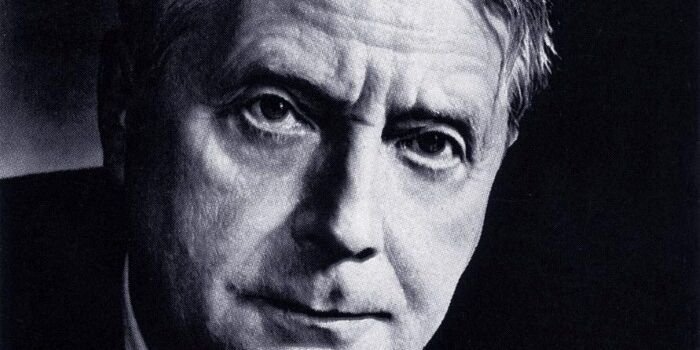
【BON音樂】《傳奇留聲:二十世紀指揮黃金時代之五嶽高峰》- 查爾斯・孟許(Charles Munch, 1891–1968)
查爾斯・孟許(1891–1968)生於史特拉斯堡,受德奧與法國音樂訓練,早年為小
[…] […]
[…] […]
[…] […]
[…] […]
[…] […]